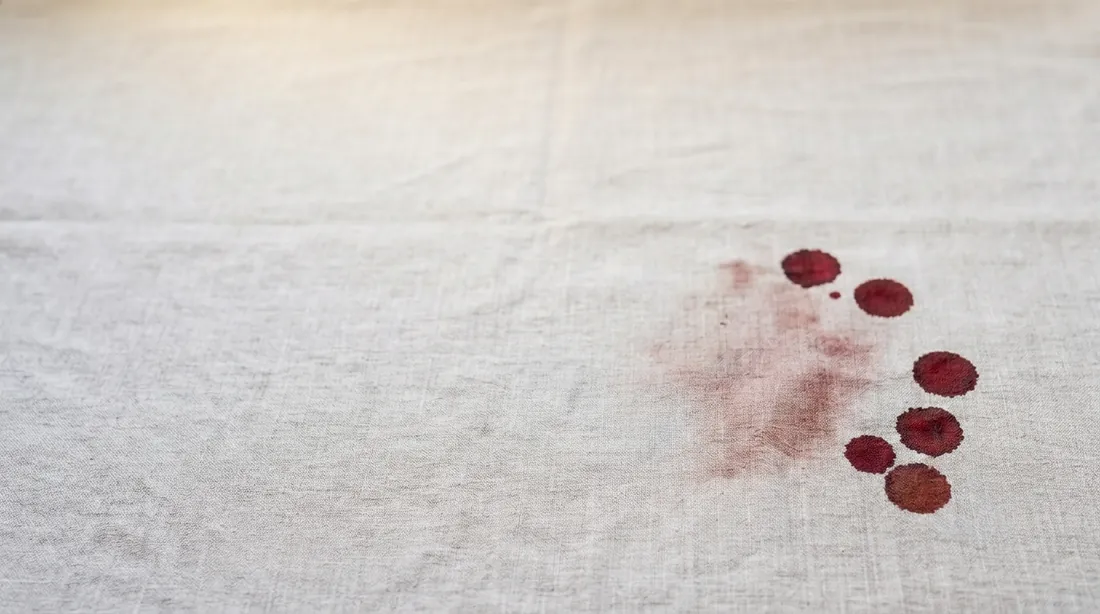
How to remove blood stains
Work fast and keep everything cold: rinse fresh blood under cold running water and rub the spot with bar soap or liquid detergent, then soak in cool water for 30 minutes or more. Persistent marks respond to a lukewarm enzyme pre-soak, and stubborn ones to a brief application of 3% hydrogen peroxide. Hot water and machine drying both set the stain. [1][2]
Rinse the stain under cold running water while it is still fresh — a set blood stain is much harder to remove. [1][2]
Do not use hot water at any point — it sets the stain — and do not machine-dry until the stain is completely gone, since drying also sets it. [2]
- Cold water
- Bar soap or liquid laundry detergent
- Enzyme pre-soak product (optional)
- 3% hydrogen peroxide (optional)
- Household ammonia (optional, for old stains)
Method
- Rinse the fresh stain in cold running water, then rub bar soap or liquid detergent into it. Rinse and repeat. [1]
- Soak the item in cool water for at least 30 minutes. A short cold-water soak with liquid detergent worked into the stain also helps loosen it. [1][2]
- If the stain persists, soak in lukewarm water with an enzyme pre-soak product, then rub liquid detergent into any remaining mark. [1]
- For an old or stubborn stain, apply a few drops of ammonia and wash again, or apply 3% hydrogen peroxide for 1–3 minutes, then rinse thoroughly. [1]
- Launder on a normal cycle in cold water without rinsing off the pretreatment detergent. [2]
After washing, check that the stain is completely gone before the item goes anywhere near a dryer. If any mark remains, repeat the treatment — drying will set it. [2]
If that didn't work
If the stain survives soaking and peroxide, use a fabric-safe bleach, or for dried-in blood wash with a detergent that has built-in pre-treaters. [1][2]
Cautions
wool, silk: Ammonia damages silk and wool. If you must use it on these fibers, dilute it with an equal amount of water and use it sparingly. [1]
Check the care label first and pretest any cleaning agent on a hidden area for colorfastness. [1]
Hot water sets blood stains permanently — use cold or cool water only. [2][1]
Synthetic carpet
Method
- Mix 1 teaspoon mild detergent into half a pint of cool water. Blot the stain with the solution without forcing it deeper into the pile, and keep going until no more stain transfers. [1]
- If needed, follow with a solution of 1 tablespoon ammonia in half a cup of water; sponge and blot repeatedly. [1]
- Place an absorbent pad over the damp area and weight it down until the carpet is dry. [1]
If that didn't work
On wool carpet, repeat blotting with the mild detergent solution only (1 teaspoon mild detergent to half a pint of cool water) until the stain lifts. [1]
Cautions
wool: Ammonia damages wool — on wool carpet stop after the detergent-solution step, or dilute ammonia with an equal amount of water and use sparingly. [1]
Upholstery cotton linen
Method
- While the stain is wet, sponge or blot it with cold water — that is often enough on its own. [1]
- Mix 1 quart cool water, half a teaspoon detergent, and 1 tablespoon ammonia. Blot with a white pad repeatedly, then rinse thoroughly so no ammonia remains. [1]
- Spray lightly with a laundry pre-soak, cover with a dampened pad for 10–15 minutes, sponge with clear water, then blot thoroughly and dry the spot quickly. [1]
If that didn't work
If cold-water blotting is not enough, apply a wet spotter (1 part glycerin, 1 part white dishwashing detergent, 8 parts cold water, a few drops of ammonia for non-protein fibers), keep it moist under a damp absorbent pad until the stain lifts, then flush thoroughly with cool water. [1]
Cautions
Pretest in a hidden spot, use cool water only, and avoid overwetting — excess moisture can migrate the fabric finish and leave rings. [1]
Upholstery silk wool
Method
- While the stain is wet, sponge or blot with cold water. [1]
- If the stain remains, apply a wet spotter made without ammonia — 1 part glycerin, 1 part white dishwashing detergent, 8 parts cold water. [1]
- Cover with a dampened absorbent pad, keeping it moist until the stain is gone, then flush with cool water. [1]
If that didn't work
Keep the ammonia-free wet spotter and damp pad in place, refreshing the moisture, until no more stain transfers, then flush with cool water. [1]
Cautions
silk, wool: Leave ammonia out of the wet spotter on these fibers — ammonia damages silk and wool. [1]
Leather upholstery
Method
- Mix a mild soap solution in cool water and work it into suds. [1]
- Apply only the foam to the stained area and rub gently. [1]
- Wipe dry, then condition the leather with saddle soap. [1]
If that didn't work
Repeat the foam-only cleaning; no stronger fetched-source method exists for blood on leather. [1]
Cautions
Use only the foam of the suds, not the liquid, and pretest in an inconspicuous area. [1]
Hard floors masonry
Method
- Wipe the spot with a sponge dampened in cool water. [1]
- If the stain remains on brick, concrete, stone, or tile, wash with a laundry detergent or washing-soda solution in warm water. [1]
- Rinse well and dry. [1]
If that didn't work
On marble, apply a thick paste of water, powdered detergent, and hydrogen peroxide bleach under a damp cloth; once the mark has bleached out, rinse thoroughly and dry. [1]
Cautions
Washing soda is highly toxic — wear gloves, avoid skin contact, and ventilate the area. [1]
Not covered by our sources
- Mattress: Neither fetched source gives a blood-on-mattress procedure; the upholstery cold-water/wet-spotter guidance is the nearest covered surface.
Where sources disagree
- After a cool soak, a persistent blood stain can be soaked in lukewarm water with an enzyme pre-soak product. [1]
- Keep the entire process cold — soak and wash in cold water only, and never use hot water because it sets the stain. [2]
We show both positions rather than silently choosing. When in doubt, follow your care label and the more conservative option.
What people report Anecdotal
Real threads from public forums, linked and labeled. These are individual experiences, not verified results, and never a substitute for the sourced method or safety guidance above.
Posters reported firsthand success getting blood out with a 60C biological-powder wash, hydrogen peroxide (on a futon), OxiClean on old stains, and antiseptic mouthwash on a mattress.
“The old stains lifted like they were never there.”
how to get blood out of sheets? — Mumsnet, 2015-07-11 · accessed 2026-08-18 · anecdotal
One poster removed a set blood stain by soaking with Vanish in warm water for an hour then machine washing; another reported hydrogen peroxide plus baking soda cleared a different set stain in two rounds.
“good shake of vanish, warm water, left it an hour, straight in the washing machine, it's perfect”
Getting set blood stain out — Mumsnet, 2019-10-27 · accessed 2026-08-18 · anecdotal
Several commenters reported firsthand that hydrogen peroxide removes blood stains, keeping bottles on hand for psoriasis scratches, nosebleeds, and period stains (one dabs it on with a Q-tip); the original question post has since been deleted but the comments remain.
“It works like magic on blood stains. They disappear in front and your eyes.”
Is a properly working washing machine supposed to clean blood stains? — r/laundry (Reddit), 2024-09-18 · accessed 2026-08-18 · anecdotal
Sources
- Institutional University of Georgia Extension — Remove Stains From Blood (accessed 2026-08-18)
- Manufacturer Tide (Procter & Gamble) — How to Remove Blood Stains (accessed 2026-08-18)
Updated 2026-08-18. Compiled from the cited sources; not independently verified by this site. Spotted an error? See the corrections policy.