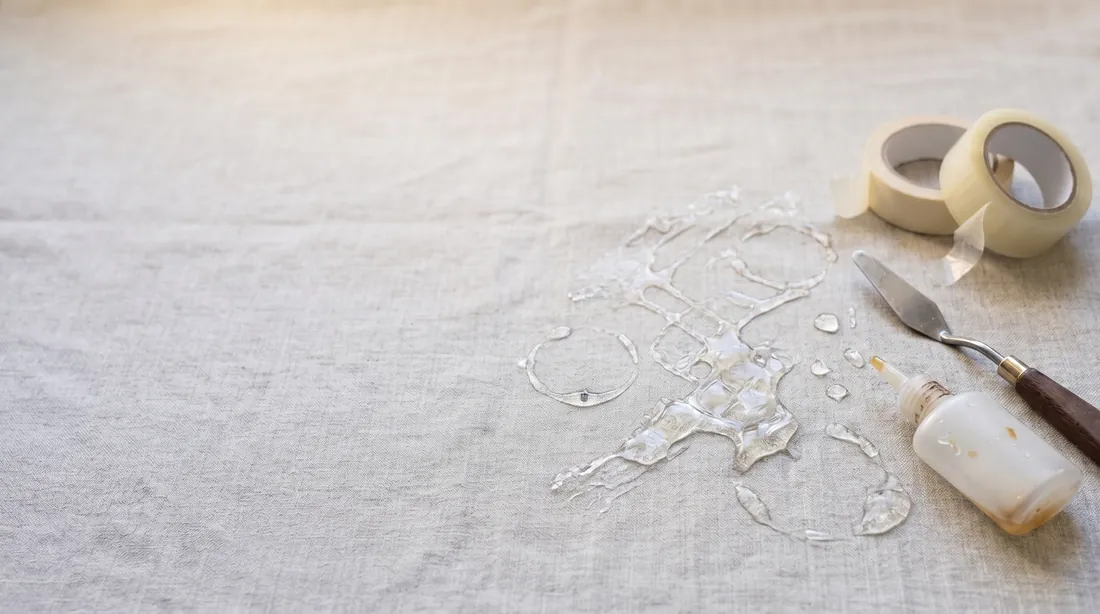
How to remove glue & adhesive residue stains
On washable fabric, harden tape or sticker residue with ice, scrape off the excess with a dull knife, then sponge the back of the stain with a commercial cleaner over paper towels and launder. White glue and school paste respond to two 15-minute soaks in lukewarm water with dishwashing liquid and ammonia followed by an enzyme soak. UGA states super glue on fabric cannot be removed, while Illinois offers a pretreat-and-launder method — a recorded conflict. [1][2][3][4]
- Ice
- Dull knife or spoon
- Absorbent paper towels
- Commercial pre-wash/pretreatment stain remover or petroleum-distillate cleaner
- Heavy-duty liquid laundry detergent
- Liquid hand dishwashing detergent and household ammonia (white glue)
- Enzyme pre-soak product (white glue)
- Chlorine bleach (only if fabric-safe) or oxygen bleach
Method
- Harden sticky residue with ice and scrape off the excess with the side of a dull knife. [1][2][5]
- For tape and sticker residue: place the stain face-down on absorbent paper towels or a clean cloth, sponge the back with a commercial cleaner or saturate with a pretreatment laundry stain remover, changing the absorbent material as it picks up the stain; rub stubborn spots with heavy-duty liquid detergent, let dry, and launder promptly. [1][2]
- For white glue or school paste: scrape off the excess, soak 15 minutes in 1 quart lukewarm water with 1/2 teaspoon liquid hand dishwashing detergent and 1 tablespoon ammonia, rub gently from the back to loosen the glue, soak another 15 minutes, and rinse; then soak at least 30 minutes in an enzyme product (several hours for an aged stain) and launder. [3]
- If a color stain remains after laundering, soak or rewash using chlorine bleach if it is safe for the fabric, or oxygen bleach. [2][3]
Confirm the residue and any color mark are gone before laundering the item normally or machine drying — glue stains that have been laundered and dried are almost impossible to remove. [2][3]
If that didn't work
For airplane (model) glue on fabric: sponge with a commercial petroleum-distillate cleaner and cover with a cleaner-dampened absorbent pad, changing it as the stain transfers; let dry, then apply amyl acetate and keep the stain moist under an amyl-acetate-dampened pad for 15 minutes, using a spoon to help loosen the glue; flush with the commercial cleaner. Sodium perborate bleach may remove the final traces. [1]
Cautions
Never mix chlorine bleach with ammonia — the fumes are hazardous. [3]
Read the care label and pretest each agent on a hidden spot; work with good ventilation, away from open flames, and wear rubber gloves with solvent cleaners. [1]
acetate: When sponging cellulose-tape residue with alcohol, test colors first and dilute the alcohol with 2 parts water for use on acetate. [1]
acetate, triacetate, modacrylic: Acetone (including acetone nail-polish remover) is not safe for acetate, triacetate, or modacrylic fabrics. [5]
Keep amyl acetate away from plastics and furniture finishes, and do not use ammonia on plastic. [1]
Carpet & rugs
Method
- Scrape the gummy matter from the carpet surface with a dull knife, spoon, or spatula — don't press hard; move the tool's edge back and forth across the stain in short strokes. [1]
- Sponge the area with a commercial dry-cleaning solvent or carpet spot lifter, blot thoroughly, and let it dry; once dry, rub your fingers through the area to restore the pile. [1]
- If the stain persists, apply a dry spotter (1 part coconut or mineral oil to 8 parts liquid dry-cleaning solvent), cover with a pad dampened in the dry spotter, changing it as it picks up the stain and keeping both moist; then sponge with dry-cleaning solvent and let dry completely. [1]
Cautions
Don't overwet — solvents can destroy the carpet backing and foam padding. [1]
Upholstery & mattresses
Method
- Gently scrape off the gummy matter with a dull knife, spoon, or spatula in short strokes, then sponge with a commercial dry-cleaning solvent or spot lifter, blot thoroughly, and let dry — for plain tape residue, repeating this solvent-sponge-and-blot cycle is Illinois's whole method. [1][6]
- If the stain persists, work in a dry spotter (1 part coconut or mineral oil to 8 parts liquid dry-cleaning solvent) under a dampened pad, changing the pad as it lifts the stain, then sponge with solvent and let dry. [1]
- For what remains, apply amyl acetate and keep the stain moist under an amyl-acetate pad for 15 minutes, blotting occasionally and covering the pad with plastic wrap to slow evaporation; finish by sponging with dry-cleaning solvent. Acetone can be substituted for amyl acetate. [1]
If that didn't work
For super glue on upholstery, Illinois suggests blotting up the excess, applying small amounts of acetone with an eye dropper and blotting immediately, repeating until no more lifts; then sponging with dry-cleaning solvent, and if a mark remains, applying hydrogen peroxide with an eye dropper before sponging with cold water and blotting dry. [4]
Cautions
acetate, triacetate, modacrylic: Use solvents sparingly — they can destroy the foam padding — and remember acetone is unsafe on acetate, triacetate, and modacrylic fabric. [1][5]
Leather & suede
Method
- Carefully scrape the gummy matter from the surface of the leather. [1]
- Dip a cloth or sponge into the suds of a mild soap, gently scrub, and dry with a clean cloth. [1]
- If residue remains, lightly apply a pad dampened with commercial dry-cleaning solvent; on leather without a finish, follow with a conditioner such as saddle soap. [1]
Cautions
Test the solvent in an inconspicuous area first — it may remove color from pigmented leather. [1]
Hard surfaces (glass, tile, metal, plastic) — labels & stickers
Method
- On glass, mirrors, ceramic tile, and metals such as brass, chromium, nickel, and silver: fold a paper towel or cloth into a thick pad the size of the label, dampen it with household ammonia, and leave it on the label for 1/2 to 2 hours, re-dampening as needed — the label will slide off. Wash with sudsy water, rinse, and wipe dry. [1]
- On plastic, Plexiglas, and melamine: dampen a cloth or cotton swab with dry-cleaning solvent and apply only long enough to loosen the label; remove the label, immediately wipe away the fluid, and wash with sudsy water, rinse, and dry. [1]
- On resilient floors and vinyl: scrape the gummy matter with a dull edge, then rub with a sponge dipped in warm sudsy water — the warm water softens the glue — rinse with warm water, and wipe dry. Do not use an abrasive product. [1]
Cautions
Do not use ammonia on plastic, and don't leave solvent sitting on a plastic surface — it will dull the finish. On a mirror, keep ammonia from running onto the backing. [1]
Not covered by our sources
- Epoxy, contact, and water based glue: Illinois publishes separate detail pages for these glue types, but they were not fetched this session; no claims recorded.
- Hot melt (glue gun) glue: No fetched source covers hot-melt glue on any surface.
- Wood furniture finishes: UGA warns amyl acetate attacks furniture finishes but the fetched fabric-focused sections give no dedicated procedure for glue on finished wood furniture; the wood-floor sudsy-foam method was captured only for floors.
Where sources disagree
- UGA states flatly that a super glue stain on apparel fabric cannot be removed. [1]
- Illinois's Stain Solutions gives a washable-fabric method for super glue — pretreatment stain remover, heavy-duty liquid detergent, immediate laundering, fabric-safe chlorine or oxygen bleach for remaining color, and dry-cleaning solvent on the back of heavy stains — plus an acetone-based method for upholstery. [4]
We show both positions rather than silently choosing. When in doubt, follow your care label and the more conservative option.
What people report
No community reports collected for this stain yet. Community reports are always linked, dated, and labeled anecdotal — we never invent them.
Sources
- Institutional University of Georgia Extension — Remove Stains From Glue (Airplane, Super, Adhesive, Cellulose Tape) (accessed 2026-08-19)
- Institutional University of Illinois Extension — Stain Solutions: Adhesive tape (accessed 2026-08-19)
- Institutional University of Illinois Extension — Stain Solutions: White glue or school paste (accessed 2026-08-19)
- Institutional University of Illinois Extension — Stain Solutions: Super glue (accessed 2026-08-19)
- Institutional Texas A&M AgriLife Extension — Removing Stains from Washable Fabrics (accessed 2026-08-18)
- Institutional University of Illinois Extension — Stain Solutions: Tape residue (accessed 2026-08-19)
Updated 2026-08-19. Compiled from the cited sources; not independently verified by this site. Spotted an error? See the corrections policy.