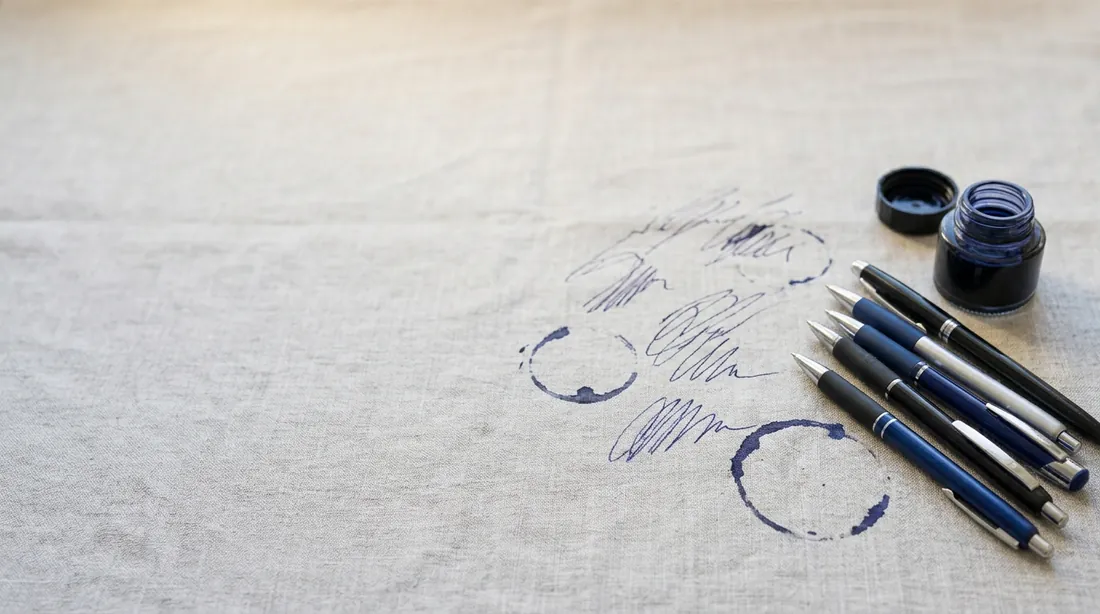
How to remove ballpoint & ink stains
Treat ink while it is fresh — laundering or drying can set it, and dried India ink may be impossible to remove. On washable fabric, sponge the stain over an absorbent pad with rubbing alcohol, acetone, or a pre-wash remover until the ink stops bleeding, then launder. Red ballpoint ink needs detergent-ammonia and vinegar soaks instead. Match the solvent to the fiber: acetone and alcohol destroy acetate-family fabrics. [1][2]
- Rubbing alcohol, acetone, or pre-wash stain remover
- Clean absorbent pads (white cloth, paper towels)
- Liquid hand dishwashing detergent
- Household ammonia and white vinegar (for red ink)
- Laundry detergent
Method
- Lay the stain face-down on a clean absorbent pad and sponge the back with acetone, rubbing alcohol, or a pre-wash remover, moving to fresh pad areas as ink transfers, until the ink stops bleeding out. [1][3]
- Let the fabric dry and repeat the solvent sponging if ink remains. [1]
- For red ballpoint or stamp-pad ink, instead soak 30 minutes in 1 quart warm water with 1/2 teaspoon liquid hand dishwashing detergent and 1 tablespoon ammonia, rinse, then soak 1 hour in 1 quart warm water with 1 tablespoon white vinegar, rinse and dry, and finish with alcohol applied on a dampened pad. [1]
- For India ink, work fast: force water through the stain to flush loose pigment, dry, sponge with a commercial cleaner, wash repeatedly with light-duty liquid detergent, then soak in 1 to 4 tablespoons ammonia per quart of water; dried stains may need an overnight soak. [1]
- Launder with detergent. If a trace remains on white or colorfast fabric, use a bleach that is safe for the fabric. [1][2]
Air-dry and inspect before any machine drying or pressing — heat sets remaining ink permanently. Repeat treatment while traces show. [2][4]
If that didn't work
If home solvents fail, try a dedicated ink remover such as Amodex applied per the maker's directions (to a dry stain, worked in, then laundered), or take the item to a professional dry cleaner and identify the stain type. [5][2]
Cautions
acetate, triacetate, modacrylic: Acetone, lacquer thinner, and acetone nail-polish remover destroy acetate, triacetate, and modacrylic fabrics — UGA warns acetate and triacetate 'turn to froth immediately.' [1][2][3]
acetate, triacetate, modacrylic, acrylic: Alcohol damages acetate, triacetate, modacrylic, and acrylic fibers and fades some dyes; on acetate dilute with 2 parts water and always pretest an inconspicuous area. [1][3]
silk, wool: Ammonia damages silk and wool; if it must be used on these fibers, dilute with an equal amount of water and use sparingly. [1][3]
Never mix ammonia with chlorine bleach — the resulting fumes are highly toxic. Rinse thoroughly between different removers. [3][2]
Solvent cleaners are poisonous and often flammable: work with good ventilation away from flames, pilot lights, and sparks; never put solvents in a washing machine or solvent-damp fabric in a dryer; keep all products away from children. Never use carbon tetrachloride, gasoline, or lighter fluid. [3][1][2]
Carpet & rugs
Method
- Sponge ballpoint ink with a commercial dry-cleaning solvent, blotting continuously and keeping solvent from soaking into the backing; never rub ink on carpet. [1]
- If it persists, apply butyl alcohol (not rubbing alcohol) with an absorbent pad, changing the pad frequently while ink keeps transferring, then blot dry. [1]
- For remaining traces, sponge with water, then apply wet spotter (1 part glycerin, 1 part white dishwashing detergent, 8 parts water) with a few drops of ammonia; let stand 30 minutes, blotting every 5 minutes and keeping it moist, then sponge with clear water and blot dry. [1]
- For red ink only, as a last resort sponge with hydrogen peroxide until the stain is removed, then sponge with clear water and dry. [1]
If that didn't work
Have the carpet professionally cleaned if the stain persists. [1]
Cautions
Do not overwet — solvents can destroy carpet backing; permanent inks on carpet are almost impossible to remove, and ink on fur carpet needs a professional. [1]
Upholstery & mattresses
Method
- Sponge lightly with a commercial solvent-based cleaner per its directions, changing the pad as ink accumulates and keeping solvent out of the foam padding. [1]
- If it persists, apply drops of butyl alcohol with an absorbent pad, keeping the area moist as long as ink transfers, then blot thoroughly and dry. [1]
- For remaining traces, sponge with water and apply wet spotter (1 part glycerin, 1 part white dishwashing detergent, 8 parts water) with ammonia drops for 30 minutes, blotting every 5 minutes; finish by sponging with clear water and blotting dry. For red ink, 3% hydrogen peroxide is the last resort. [1]
Cautions
Overwetting can make the upholstery finish migrate and leave a ring; dilute vinegar 2 parts water to 1 part vinegar on cotton or linen; dilute ammonia on silk and wool. [1]
Leather & suede
Method
- Apply a commercial leather cleaner, rub with a clean cloth, and dry; if the stain persists, try a commercial solvent-based cleaner after testing on a hidden seam (it may strip pigmented leather color), then air-dry and condition untreated leather. [1]
Cautions
Ink can act on the hide immediately — once contact is made there is no guaranteed way to remove it, and MSU advises against attempting major home stain removal on suede or leather garments. [1][3]
Hard floor resilient
Method
- Apply an all-purpose spray cleaner per its label; if a trace remains, cover with an absorbent pad moistened with rubbing alcohol, then rinse with clear water. [1]
- On linoleum or vinyl, if the mark persists, rub with superfine (#0000) steel wool dipped in liquid floor wax, wash with soapy water, dry, and re-wax. [1]
Cautions
Do not use ammonia on linoleum or vinyl. [1]
Where sources disagree
- Sponging with rubbing alcohol, acetone, or pre-wash remover (and water-flushing fresh India ink) is the primary home treatment for ink on washable fabric. [1][3]
- Never wet an ink stain first — water and detergents can permanently set stains, and alcohol or hairspray will only worsen ink marks; apply their remover to the dry stain instead. [5]
We show both positions rather than silently choosing. When in doubt, follow your care label and the more conservative option.
Third-party tests Not our test
Your Best Digs: In-house test of seven stain-remover products on white cotton shirts stained with coffee, wine, chocolate-hazelnut spread, and ink; stains were set for one week on the front and applied fresh on the back, then each product was used per label and washed identically.
OxiClean Versatile Stain Remover won overall, clearing all tested stains via soaking (ink faded substantially rather than vanishing). Tide To-Go pen was the portability pick and Shout Advanced Gel the gentlest on fabric.
The Best Laundry Stain Removers of 2026 · 2022-01-19 · accessed 2026-08-18 · third-party test — not our test
What people report Anecdotal
Real threads from public forums, linked and labeled. These are individual experiences, not verified results, and never a substitute for the sourced method or safety guidance above.
One poster reported firsthand that a Stain Devils three-pack worked on almost everything including biro; other suggestions in the thread (hairspray, rubbing alcohol) were offered without personal results.
“I had a set of three and it worked for pretty much everything”
How to get biro out of cotton? — Mumsnet, 2023-01-22 · accessed 2026-08-18 · anecdotal
One commenter reported firsthand that Amodex reliably removes ballpoint ink from white chef jackets and that Carbona ink remover works but takes time; another gave up on an ink-stained dress after a hairspray treatment, yet the ink eventually came out with repeated washings.
“Carbona ink remover works but takes time. My personal favorite is Amodex.”
How do you remove a permanent ballpen ink in clothes? — r/laundry (Reddit), 2025-02-28 · accessed 2026-08-18 · anecdotal
The poster reported a big grease stain on borrowed shorts came out completely after 10 minutes of rubbing alcohol, a cold rinse, Dawn dish soap scrubbed in, and a regular wash, and said the same routine later removed an ink stain from a pair of pants.
“I did rubbing alcohol for 10 minutes, rinsed with cold water, dawn dish soap scrubbed in, rinsed and then regular wash. Gone!”
Grease stain gone! — r/laundry (Reddit), 2021-06-11 · accessed 2026-08-18 · anecdotal
The poster reported a big grease stain on borrowed shorts came out completely after 10 minutes of rubbing alcohol, a cold rinse, Dawn dish soap scrubbed in, and a regular wash, and said the same routine later removed an ink stain from a pair of pants.
“I did rubbing alcohol for 10 minutes, rinsed with cold water, dawn dish soap scrubbed in, rinsed and then regular wash. Gone!”
Grease stain gone! — r/laundry (Reddit), 2021-06-11 · accessed 2026-08-18 · anecdotal
Sources
- Institutional University of Georgia Extension — Remove Stains from Ink (Ballpoint, Felt Tip, India, Mimeo, Stamp Pad) (accessed 2026-08-18)
- Institutional Texas A&M AgriLife Extension — Removing Stains from Washable Fabrics (accessed 2026-08-18)
- Institutional Michigan State University Cooperative Extension Service — Stain Out — A General Guide to Stain Removal (Extension Bulletin E-1453) (accessed 2026-08-18)
- Institutional Iowa State University Extension and Outreach — Removing More Summer Stains (AnswerLine) (accessed 2026-08-18)
- Manufacturer Amodex Products — Stain Solutions / FAQ — Amodex Ink & Stain Remover (accessed 2026-08-18)
Updated 2026-08-18. Compiled from the cited sources; not independently verified by this site. Spotted an error? See the corrections policy.