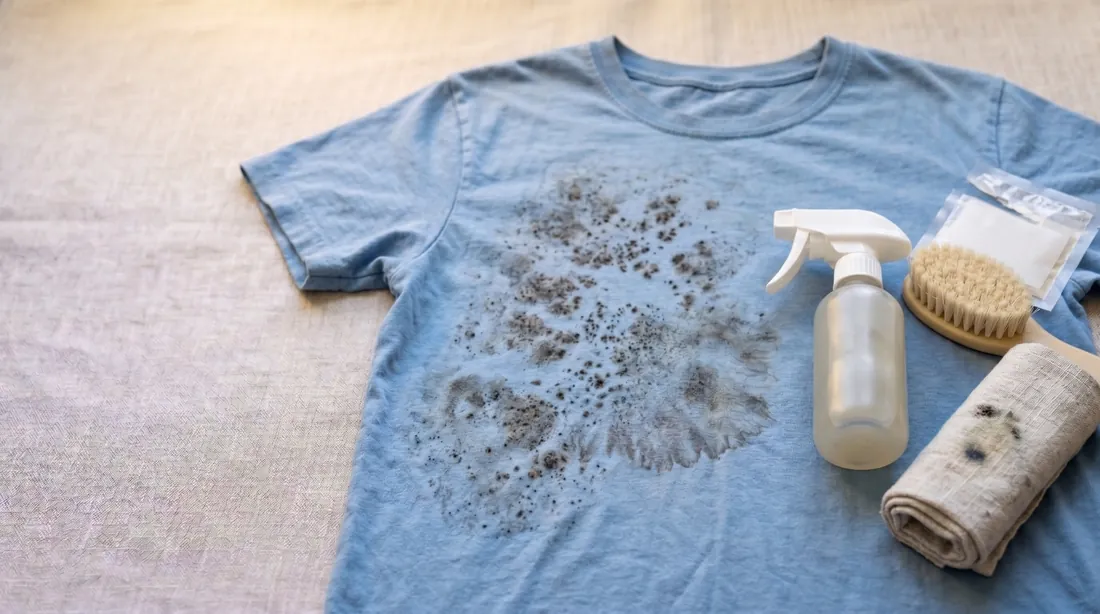
How to remove mildew & mold stains
Take the item outdoors and brush or shake off the mildew, work heavy-duty liquid detergent into the spots, and launder in the hottest water the fabric allows with a fabric-safe bleach. A persistent stain can soak 10–15 minutes in 1/4 cup chlorine bleach (if fabric-safe) or sodium perborate bleach mixed with 3/4 cup water. Mildew attacks the fibers themselves, so bleaching may not restore whiteness, and several launderings may be needed. [1][2][3]
- Brush (use outdoors)
- Heavy-duty liquid laundry detergent
- Chlorine bleach (only if fabric-safe) or sodium perborate/oxygen bleach
- Salt and lemon juice (sunlight alternative)
Method
- Brush or shake the mildew off outdoors. [1][2][3]
- Work heavy-duty liquid detergent into the spots — pretreat the darkest stains — then launder in the hottest water safe for the fabric with heavy-duty detergent and a bleach that is safe for the fabric. [2][3][1]
- If the stain persists, soak it 10–15 minutes in a solution of 1/4 cup chlorine bleach (only if fabric-safe) or sodium perborate bleach mixed with 3/4 cup water, then launder again. [1]
- As a bleach-free alternative, treat the spots with salt and lemon juice, dry the item in direct sunlight, then rinse and launder. [1]
Inspect before machine drying. Mildew is difficult to remove and may take several launderings — repeat the detergent-and-bleach laundering if traces remain rather than drying the item. [3][2]
If that didn't work
UGA's solvent sequence for stubborn fabric mildew: flush with a commercial cleaner (petroleum-distillate type such as Goof Off or K2r), apply amyl acetate and pat with a cleaner-dampened absorbent pad, flush and let dry; sponge with water, apply diluted hand dishwashing detergent with vinegar and pat; flush with water and dry; then apply alcohol, pat with an alcohol-dampened pad and flush with alcohol. If the stain still remains, use chlorine bleach if the fabric allows it. [1]
Cautions
Mildew attacks and destroys the fibers themselves, so even successful bleaching may not restore the fabric to white. [2]
Never mix chlorine bleach and ammonia — the fumes are hazardous. [2][1]
silk, wool, cotton, linen: Chlorine bleach dissolves silk and wool, and over time it yellows and weakens cotton and linen — reserve it for fabrics whose care label permits it. [4]
acetate, triacetate, modacrylic, acrylic: Read the care label first and pretest every cleaning agent on a hidden spot. Solvent cleaners need good ventilation, no open flames, and rubber gloves; alcohol damages acetate, triacetate, modacrylic, and acrylic fibers (dilute with 2 parts water on acetate). [1]
Carpet & rugs
Method
- Dry the carpet out first to stop the growth: run a dehumidifier, open windows and use fans, let sunlight in, and lift the carpet so air circulates underneath. [1]
- Kill the spores by exposing the rug or carpet to direct sunlight for 1–2 days, or paint on a solution of 1 part 3% hydrogen peroxide to 5 parts water and place it in the sunshine. [1]
- Vacuum the surface to draw out the mold, then immediately remove and dispose of the vacuum bag so spores don't scatter in the house. [1][2]
- Sponge the area lightly with thick suds of dishwashing detergent swished in water — be sparing with the water — then wipe with a clean, damp cloth and dry in the sun if possible, blotting away excess moisture. [1][2]
If that didn't work
If stains remain, sponge with a commercial dry-cleaning solvent, then apply a dry spotter (1 part coconut or mineral oil to 8 parts liquid dry-cleaning solvent) with a dampened pad, sponge with solvent again and let dry; for persistent marks follow with a wet spotter (1 part glycerin, 1 part white dishwashing detergent, 8 parts water plus a few drops of white vinegar), rinse with clear water, and dry under a weighted absorbent pad. If mold has grown into the inner flooring, call a commercial rug cleaner — the piece may not be cleanable and may need to be thrown out. [1][2]
Cautions
Take care with electrical appliances around a wet carpet to prevent electrical shock. [1]
Don't overwet with solvent cleaners — solvents can destroy the carpet backing and foam padding. [1]
Upholstery & mattresses
Method
- Brush loose mold spores off with a soft-bristled broom, outdoors if possible (wash the broom before reusing it), then vacuum the surface and dispose of the vacuum bag immediately or clean the canister outside. [1][2]
- If the piece is damp, dry it with an electric fan and heater, and put it in direct sunlight if you can — sun and air stop mold growth. [1][2]
- Sponge the stain with a commercial dry-cleaning solvent, blot, and let dry; then sponge with water and apply a dry spotter made of 1 part coconut oil, 8 parts liquid dry-cleaning solvent, and a few drops of ammonia, working with an absorbent pad, and finish by sponging with water. [1]
- For remaining marks, wipe with a cloth moistened in a solution of 1 cup denatured or rubbing alcohol and 1 cup water, then blot thoroughly and let it dry, in sun and air if possible. [1]
If that didn't work
Illinois's alternative: sponge the stain with a solution of 1 cup ammonia in 1 cup cool water using a clean white cloth, blotting until the liquid is absorbed and repeating until the stain disappears; then sponge with cold water, blot dry, and dry the piece thoroughly with a fan or a hair dryer on the cool setting. Never mix the ammonia solution with chlorine bleach. [2]
Cautions
silk, wool: Ammonia damages silk and wool — if you must use it on those fibers, dilute it with an equal amount of water and use it sparingly. Never let ammonia and chlorine bleach mix. [1][2]
acetate, triacetate, modacrylic, acrylic: Overwetting with water can make the upholstery fabric's finish migrate and leave a circle; solvents can destroy the foam padding. Alcohol damages acetate, triacetate, modacrylic, and acrylic fibers — dilute with 2 parts water on acetate. [1]
Not covered by our sources
- Leather & suede: UGA lists leather among upholstered-furniture cover types, but the page content fetched this session could not be reliably attributed to leather (the leather-specific steps appeared mis-placed in the fetched extraction). No leather claims recorded; refer to a leather-care professional.
- Dry clean only garments: No fetched source gives a home procedure for mildew on dry-clean-only clothing.
What people report
No community reports collected for this stain yet. Community reports are always linked, dated, and labeled anecdotal — we never invent them.
Sources
- Institutional University of Georgia Extension — Remove Stains From Mildew/Mold (accessed 2026-08-19)
- Institutional University of Illinois Extension — Stain Solutions: Mildew (accessed 2026-08-19)
- Institutional Texas A&M AgriLife Extension — Removing Stains from Washable Fabrics (accessed 2026-08-18)
- Institutional Smithsonian Museum Conservation Institute — Stain Removal (accessed 2026-08-18)
Updated 2026-08-19. Compiled from the cited sources; not independently verified by this site. Spotted an error? See the corrections policy.