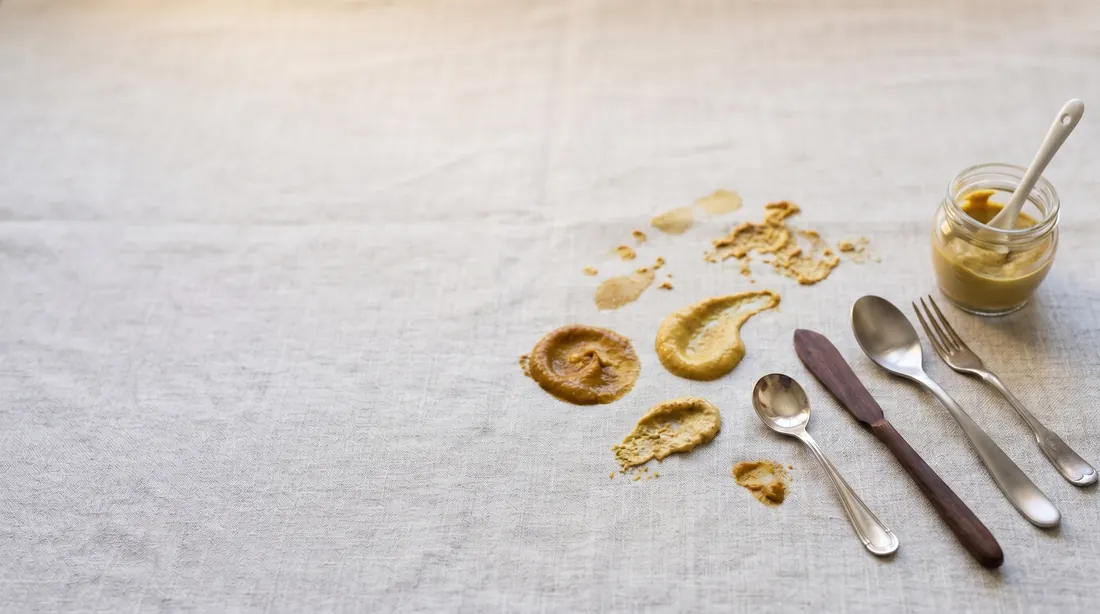
How to remove mustard stains
Mustard gets its color from turmeric, a yellow dye, and can become impossible to remove if it isn't treated immediately. Scrape off the excess, sponge with a petroleum-distillate cleaner or pre-wash stain remover, work in light-duty liquid detergent with a few drops of vinegar, and rinse well; apply 3 percent hydrogen peroxide to a remaining mark, then launder. Persistent stains move to bleach soaks — check the item is stain-free before it hits the dryer. [1][2][3]
- Dull knife, spatula, or plastic card (to scrape)
- Pre-wash soil and stain remover or a petroleum-distillate commercial cleaner
- Light-duty liquid detergent
- White vinegar
- 3% hydrogen peroxide
- Heavy-duty liquid detergent
- All-fabric (color-safe) powdered bleach
- Liquid chlorine bleach (white or colorfast items only)
Method
- Scrape off the excess mustard, then sponge the stain with a commercial cleaner containing petroleum distillates (such as Goof Off, Goo Gone, or K2r) or apply a pre-wash soil and stain remover. Rinse. [1]
- Work a light-duty liquid detergent and a few drops of vinegar into the stain, then rinse well. [1]
- If the stain remains, apply 3 percent hydrogen peroxide, rinse, and launder. [1]
- For a stain that survives laundering, pretreat with heavy-duty liquid detergent, rinse, and soak in a dilute solution of all-fabric powdered bleach. [2][3]
- If the stain persists and the garment is white or colorfast, soak the whole garment in a diluted chlorine-bleach solution after checking bleach tolerance on a hidden seam. If the stain hasn't come out after 15 minutes of bleaching, bleaching won't remove it — and longer bleaching can weaken the fabric. [2][3]
Inspect the wet item before it goes in the dryer: if any yellow remains, do not machine-dry — drying heat sets the stain and makes it more permanent. [3]
If that didn't work
If bleaching isn't safe for the fabric or doesn't work, a commercial color remover used according to package directions is the last resort — it will strip the fabric's own color along with the stain. Don't exceed 160°F water with any synthetic fabric (acetate, acrylic, polyester, nylon, olefin, triacetate, or anything labeled permanent-press or wrinkle-resistant). [2]
Cautions
Read the care label before treating, never use a product the label prohibits, and pretest every cleaning agent on an inconspicuous area for colorfastness. [1]
Never mix chlorine bleach and ammonia — the fumes are hazardous. [2]
Provide ventilation when using commercial or caustic cleaning solutions, and store and dispose of products out of reach of children. [1]
colored fabrics: Chlorine bleach can change a garment's color or cause irreversible damage — check bleach tolerance on a hidden seam first. [2]
silk, wool: Ammonia damages silk and wool. If you must use it on these fibers, dilute it with an equal amount of water and use it sparingly — and be prepared to live with a faint yellow or red mark, because mustard is a very difficult stain. [1]
Why this works
Mustard contains turmeric, a yellow dye, which is why extension guides class it as a dye stain — one of the hardest categories to remove — and why an untreated spill can become permanent. [1][3][4]
Carpet & rugs
Method
- Remove the excess with a dull knife, spatula, or plastic card, sponge with clear cool water, and blot with a clean white absorbent cloth. [1]
- If the stain remains, sponge on a solution of 1 part ammonia to 4 parts water and blot with a rotating clean cloth until no more stain lifts. Ammonia will turn the yellow stain red — decide which color would show less on your carpet before using it. [1]
- Spray the area with a general-purpose household cleaner, cover with an absorbent pad moistened in the solution for 10–15 minutes, then sponge with clear cool water until every trace of ammonia and cleaner is out. Blot, weight folded absorbent cloths over the spot for several hours, then reset the pile and let the carpet air-dry. [1]
If that didn't work
An ammonia-free alternative: sponge with 1 teaspoon dishwashing detergent in 1 cup lukewarm water, then 1/3 cup white vinegar in 2/3 cup water, and finish with an enzyme-product solution left on the stain for the label-recommended time before rinsing and blotting dry. [2]
Cautions
wool: Ammonia damages silk and wool carpet fibers — dilute with equal parts water and use sparingly, and accept that a slight yellow or red mark may remain. [1]
Upholstery & mattresses
Method
- On a fresh stain, spray with a commercial fabric spot cleaner following the container directions. [1]
- On an older stain, scrape off what you can, sponge with clear water, apply a drop or two of white dishwashing detergent from a medicine dropper, and sponge and blot with a water-moistened cloth until the detergent is out and the stain is gone. [1]
- Alternatively, sponge with 1 tablespoon liquid dishwashing detergent in 2 cups cool water, blotting until the liquid is absorbed, then sponge with cold water and blot dry to remove the detergent. [2]
If that didn't work
On silk, wool, acetate, rayon, or fiberglass upholstery: apply drops of dry-cleaning solvent and gently scrape with a dull knife; then a wet spotter (1 part glycerine, 1 part white dishwashing detergent, 9 parts water) with a few drops of white vinegar; if the stain still persists, moisten with 3 percent hydrogen peroxide plus a drop of ammonia for no more than 15 minutes, sponge with clear water, and dry. Do not use ammonia on silk or wool, and apply solvent slowly on ring-prone acetate and rayon. [1]
Cautions
Take care not to spread the stain or over-wet the fabric and stuffing. [1]
Hard floor resilient
Method
- Immediately wipe up the spill with a cloth or sponge dipped in warm sudsy water. [1]
- Rinse the area thoroughly. [1]
- Wipe dry with a soft cloth. [1]
If that didn't work
Speed is the only remedy the source offers for resilient flooring — wipe immediately; a set turmeric stain may be permanent. [1]
Cautions
Mustard's turmeric dye can be impossible to remove if not treated immediately, and set mustard is almost impossible to get out of plastic materials. [1]
Wood finished
Method
- Immediately mix dishwashing detergent into hot water and swish it into a large volume of suds. [1]
- Dip a cloth in only the foam and apply it to the mustard stain. [1]
- Rinse with a clean cloth dampened in cool clear water, and polish or wax when dry. [1]
If that didn't work
Repeat the suds-only application rather than wetting the wood; the source gives no harsher option for finished wood. [1]
Cautions
Treat immediately — untreated mustard can stain permanently. [1]
Leather & suede
Method
- Mix a solution of mild soap in lukewarm water, swishing to create a large volume of suds. [1]
- Apply only the suds to a sponge and wipe the stained area, then wipe with a clean cloth dampened in clear water and dry with a soft cloth. [1]
- Follow with a commercial leather conditioner to restore the leather's luster and softness. [1]
If that didn't work
The source offers no stronger treatment for leather than the mild-soap suds and conditioner routine. [1]
Cautions
Use suds only — don't soak the leather. [1]
Not covered by our sources
- Suede: No fetched source covers mustard on suede garments; UKY's general guidance is not to treat suede, leather, or fur yourself but to use a dry cleaner that specializes in leather care.
- Mattress: No source fetched this session gives mustard-specific instructions for mattresses.
Where sources disagree
- Mustard is a dye stain (wet type): pretreat with detergent, rinse, then escalate through color-safe bleach and chlorine bleach — dye stains are among the hardest to remove. [4][3]
- Mustard is listed among oil-based stains: use heavy-duty detergent with hot water. [5]
We show both positions rather than silently choosing. When in doubt, follow your care label and the more conservative option.
What people report
No community reports collected for this stain yet. Community reports are always linked, dated, and labeled anecdotal — we never invent them.
Sources
- Institutional University of Georgia Extension — Remove Stains From Mustard (accessed 2026-08-19)
- Institutional University of Illinois Extension — Stain Solutions: Mustard (accessed 2026-08-19)
- Institutional Iowa State University Extension and Outreach — Holiday Stains (AnswerLine) (accessed 2026-08-18)
- Institutional Texas A&M AgriLife Extension — Removing Stains from Washable Fabrics (accessed 2026-08-18)
- Institutional University of Kentucky Cooperative Extension Service — Stain Removal for Washable Fabrics (FCS2-840 / H.E. 2-840) (accessed 2026-08-18)
Updated 2026-08-19. Compiled from the cited sources; not independently verified by this site. Spotted an error? See the corrections policy.