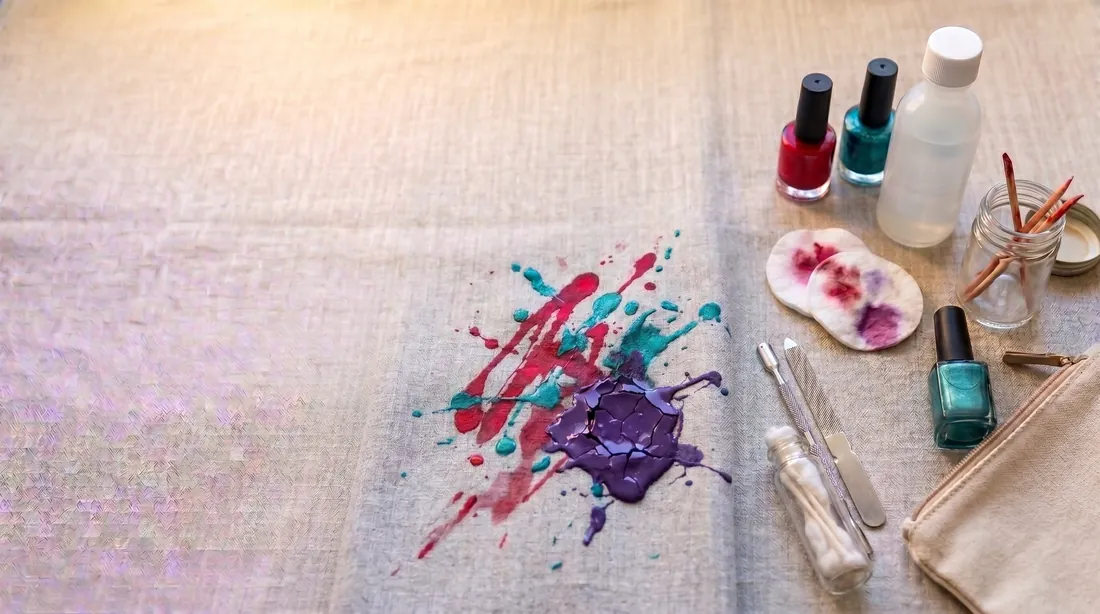
How to remove nail polish stains
The core treatment for washable fabric is acetone or nail polish remover applied to the back of the stain over absorbent material, then laundering — but never on acetate, triacetate, or modacrylic, which the solvent dissolves; those garments go to a dry cleaner. Amyl acetate is the drug-store alternative. Treat before washing: polish that has been laundered and dried is almost impossible to remove. [1][2][3]
- Dull knife or credit card (to scrape)
- Acetone or non-oily nail polish remover
- Amyl acetate (drug store) as an alternative
- Paper towels or absorbent pads
- Rubbing alcohol and household ammonia
- Laundry detergent
Method
- Check the fiber content first. If the garment contains acetate, triacetate, or modacrylic fibers, do not use nail polish remover or acetone — take it to a dry cleaner and identify the stain. [2][3][1]
- On other washable fabrics, place the stain face down on paper towels or absorbent material and sponge the back of the stain with acetone or amyl acetate, rotating the towel as it absorbs polish. Repeat, flushing with more remover, until no more stain comes out. [1][2][3]
- If a trace remains, sponge it with rubbing alcohol mixed with a few drops of ammonia. [1]
- Rinse and launder according to the care label. [2][1][3]
Confirm the polish is completely gone before the item is laundered and machine-dried — stains that have been through the wash and dryer are almost impossible to remove. [2]
If that didn't work
If solvent treatment leaves a mark, sponge the area with alcohol mixed with a few drops of ammonia and launder again. On acetone-sensitive fabrics (acetate, triacetate, modacrylic), skip home treatment entirely and send the garment to the dry cleaner with the stain identified. [1][2][3]
Cautions
acetate, triacetate, modacrylic: Acetone, lacquer thinner, and acetone-based removers dissolve acetate and triacetate — UGA says these fabrics 'turn to froth immediately' — and Illinois and Texas A&M extend the warning to modacrylic. Test any non-acetone remover on the fabric before using it. [1][2][3]
Read the care label before treating, never use a product the label prohibits, and pretest every cleaning agent on an inconspicuous spot for colorfastness. [1][2]
Solvents need adequate ventilation and no open flames nearby; wear rubber gloves, and store and dispose of products out of children's reach. [1]
Fingernail polish remover is not pure acetone — the other ingredients in it can make the stain worse. Keep remover and amyl acetate off plastics, furniture finishes, and vinyl; acetone quickly damages wood finishes and remover left on vinyl damages it permanently. [1]
Carpet & rugs
Method
- Blot up excess with a white paper towel or scrape it off with a dull knife as soon as possible, before the polish dries. [2][1]
- Apply rubbing alcohol to a white cloth, paper towel, or cotton ball and blot (if the spot is deep in the pile) or rub in one direction only — never in circles, which can destroy the texture. Do not let the alcohol soak down into the backing; it destroys the latex bond. [2]
- Work in a detergent solution (1/4 teaspoon hand dishwashing detergent without lanolin or bleach in 1 quart of water) with a blotting motion until no more stain lifts, then rinse with tap water from a spray bottle and blot. [2]
- Spray the area lightly with water once more, cover with a pad of paper towels weighted with a brick, and let it dry. [2]
If that didn't work
If color remains, moisten the tufts with 3% hydrogen peroxide, let it stand one hour, blot, and repeat until the stain is gone — light converts the peroxide back to water, so no rinsing is needed; finish with a weighted pad of paper towels. UGA's alternative for natural fibers, synthetics, and wool is an amyl acetate-dampened pad kept moist about 15 minutes, followed by a commercial spot remover. [2][1]
Cautions
acetate, triacetate, acrylic: Do not use lacquer thinner or acetone on acetate or triacetate carpet — it froths immediately — and don't use nail polish remover on acrylic carpet fibers; pretest remover in an inconspicuous spot first. UGA notes remover isn't pure acetone and its other ingredients can worsen the stain. [1][2]
Don't overwet carpet with solvent-based cleaners — solvents can destroy the carpet backing. [1]
Upholstery & mattresses
Method
- Carefully blot up the excess polish. [2]
- Apply a small amount of acetone to the stain with an eye dropper and blot immediately; repeat until no more polish transfers. [2]
- Sponge the area with a dry-cleaning solvent using a clean white cloth and blot until the solvent is absorbed. [2]
- If a mark remains, drop 3% hydrogen peroxide directly on it with an eye dropper, then sponge with cold water and blot dry to remove the peroxide. [2]
If that didn't work
On cotton, linen, acrylic, nylon, olefin, or polyester upholstery, sponge the stain with amyl acetate, blot with an absorbent pad, then sponge with clear water to remove the chemical residue and let it dry thoroughly. [1]
Cautions
acetate, rayon, triacetate, modacrylic, silk, wool: On acetate, rayon, triacetate, modacrylic, silk, or wool upholstery, UGA uses a Dry Spotter (1 part coconut or mineral oil to 8 parts liquid dry-cleaning solvent) under a moistened pad instead of acetone, finishing with a light dry-cleaning-solvent sponge — and warns that acetone turns acetate and triacetate to froth. [1]
Don't overwet upholstery with solvents — they can destroy the foam padding underneath. [1]
Leather suede vinyl
Method
- Carefully scrape off the excess polish. [1]
- Whip mild soap in lukewarm water into a big volume of suds, apply only the foam to the stain with a sponge, and dry with a clean cloth. If the polish has hardened, rub it gently with an art-gum eraser. [1]
- Blot the stain lightly with an absorbent pad dampened with amyl acetate (or non-oily nail polish remover), changing pads as the stain lifts. [1]
If that didn't work
Repeat the suds-and-eraser routine followed by light amyl acetate blotting rather than escalating; pretest first on a hidden area. [1]
Cautions
vinyl: Nail polish and polish remover will damage vinyl permanently if left on the surface — remove them quickly. [1]
Not covered by our sources
- Dry clean only garments beyond identifying the stain: Fetched sources only say to send acetone-sensitive fabrics (acetate, triacetate, modacrylic) to a dry cleaner and identify the stain; none describes an at-home method for dry-clean-only clothing.
Where sources disagree
- Illinois offers remover as a carpet method: apply it drop by drop to soften the polish, blot or scrape away, then shampoo — after pretesting, and never on acrylic fibers. [2]
- UGA warns that fingernail polish remover is not pure acetone and its other ingredients can make a carpet stain worse — 'use at your own risk' — preferring amyl acetate. [1]
We show both positions rather than silently choosing. When in doubt, follow your care label and the more conservative option.
What people report
No community reports collected for this stain yet. Community reports are always linked, dated, and labeled anecdotal — we never invent them.
Sources
- Institutional University of Georgia Extension — Remove Stains From Fingernail Polish, Lacquer (accessed 2026-08-19)
- Institutional University of Illinois Extension — Nail polish — Stain Solutions (accessed 2026-08-19)
- Institutional Texas A&M AgriLife Extension — Removing Stains from Washable Fabrics (accessed 2026-08-18)
Updated 2026-08-19. Compiled from the cited sources; not independently verified by this site. Spotted an error? See the corrections policy.