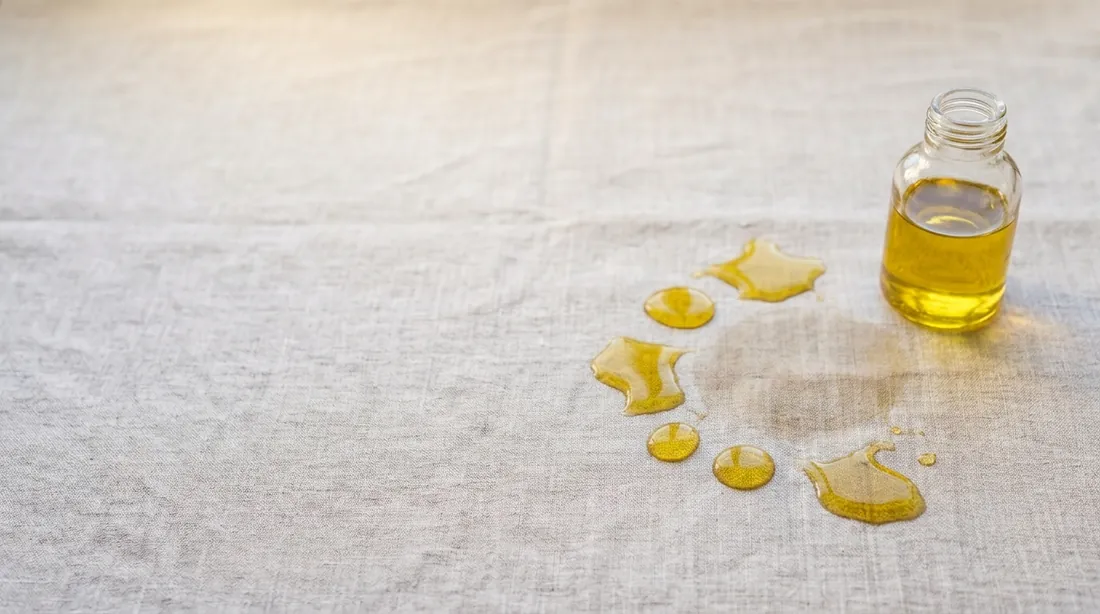
How to remove cooking oil & grease stains
Absorb what you can, then get an oil-cutting pretreatment into the fibers and launder immediately in the hottest water the care label allows. Talcum powder or another absorbent lifts free grease; an aerosol pre-wash remover, heavy-duty liquid detergent, or dish soap rubbed into the stain breaks up the rest. Check before machine drying — heat sets what remains. [1][2][3]
Blot up free oil or grease with paper towels — press, don't rub, so you don't spread it or drive it deeper. On fabric, sprinkle talcum powder (or an absorbent like baking soda or cornstarch) over the spot to soak up grease, let it work, then brush or vacuum it off. [1][4][2]
Don't rub or wipe the spill — wiping spreads it. Don't machine dry until the stain is fully gone; stains that are laundered and dried are almost impossible to remove. Never pour dry-cleaning solvent directly onto carpet or upholstery, and never put dish soap in the washing machine itself — it over-suds. [4][2][3]
- Paper towels
- Talcum powder, baking soda, or cornstarch
- Pre-wash stain remover (aerosol) or heavy-duty liquid detergent
- Liquid dish soap (option)
- Dry-cleaning solvent (for heavy stains, carpet, upholstery)
Method
- Absorb first: sprinkle talcum powder on the greasy area, let it soak up the oil, and brush it off thoroughly. [1]
- Pretreat: saturate the stain with a commercial pre-wash stain remover (aerosol types work better on greasy stains) and give it about a minute to penetrate, or rub heavy-duty liquid detergent — or a few drops of liquid dish soap worked in with your fingers — directly into the stain. [2][1][3]
- Launder immediately in the hottest water that is safe for the fabric, using a heavy-duty liquid detergent. [1][2]
- If any color or shadow remains after washing, soak or rewash using chlorine bleach if the fabric allows it, or oxygen (all-fabric) bleach otherwise. [2]
Air-dry and inspect before the item goes anywhere near a dryer. Treat and rewash while the stain is fresh — the older the stain the harder it gets, and a stain that has been laundered and dried is almost impossible to remove. [2]
If that didn't work
For heavy or set grease, work from the back: lay the stain face-down on absorbent paper towels, apply dry-cleaning solvent to the back of the stain, let it dry, rinse, then repeat the pretreat-and-launder routine. Repeat the whole treatment if needed. [2][1]
Cautions
all fabrics: Read the care label first and pretest any cleaner on an inconspicuous area for colorfastness. [1][4]
all surfaces: Dry-cleaning solvents and petroleum solvents are flammable and their vapors are hazardous: work with good ventilation, keep them away from open flames and pilot lights, and wear rubber gloves. [4][1]
silk, delicates: If using dish soap as a pretreater, spot test first, keep it off delicate fabrics like silk, and use less than two teaspoons total if the item goes into a top-loading machine. [3]
carpet, upholstery: Don't overwet carpet or upholstery with solvent — it can destroy the carpet backing and foam padding underneath. [4][1]
Why this works
Absorbent powders draw free grease out of the material, solvents dissolve what has soaked in, and detergent solutions emulsify and suspend the remaining oil so water can carry it away. Dish soap works as a pretreater because it is formulated specifically to break up grease. [1][3]
Carpet & rugs
Method
- Blot up the excess with paper towels without rubbing. [1][4]
- Dampen a clean white cloth with dry-cleaning solvent and lay it on the spot (never pour solvent onto the carpet); press briefly so the solvent works on the stain, and swap to clean cloth sections until grease stops transferring. Let dry. [4][1]
- Apply a combination solvent product (e.g., Shout or Spray 'n Wash) to a cloth — not the carpet — and blot toward the center of the stain, rotating the cloth; agitate gently with an old toothbrush if needed. Alternatively, blot with rubbing alcohol using straight blotting motions, never circular ones. [1][4][2]
- Finish with 1 teaspoon of neutral detergent in 1 cup of lukewarm water: sponge, blot, rinse with clear water, blot again, and let dry. Reset the nap by brushing, and stack several dry cloths under a weight to pull out remaining solvent. [1][4]
If that didn't work
If greasy discoloration persists, seek professional carpet cleaning or consider patching the damaged area. [1][4]
Cautions
carpet: Pretest for colorfastness and avoid overwetting — solvents can destroy carpet backing and padding. [1]
Upholstery fabric
Method
- Sprinkle baking soda, cornstarch, or another absorbent on the stain, wait 10–15 minutes, then vacuum it up. [2]
- Sponge the spot with dry-cleaning solvent on a clean white cloth, pressing briefly and rotating to clean sections as the stain transfers; blot and repeat until it stops improving, then let dry. Brush or vacuum away any white powdery residue. [2][5][1]
- If stain remains, apply a dry spotter (1 part coconut or mineral oil mixed with 8 parts dry-cleaning solvent) on a folded white pad; keep the pad moist and change it as it picks up stain, then sponge the area with plain solvent and let dry. [1][4]
- If stain still remains, apply a wet spotter (1 part glycerin, 1 part white dishwashing detergent, 8 parts water, plus a few drops of white vinegar) the same way, then sponge with clear water, blot thoroughly, and air dry. [1][4]
If that didn't work
Sponge the cleaned area thoroughly with liquid dry-cleaning solvent, blot, and let dry; repeat the full sequence if the stain slowly improves. [4]
Cautions
upholstery: Overwetting with water can make the upholstery finish migrate and leave rings; solvent overwetting can destroy the padding. On cotton or linen, dilute vinegar with 2 parts water to 1 part vinegar; on acrylic, cotton, linen, modacrylic, olefin, or polyester UGA substitutes ammonia for vinegar in the wet spotter. [1][4]
Concrete masonry
Method
- Soak up free-standing oil or grease immediately with paper towels (don't wipe — it spreads), then cover the area with an absorbent such as cornmeal, sand, sawdust, dry cement, or kitty litter and leave it for several hours to a day; sweep up and repeat until no more oil is absorbed. [4][1]
- Scrub fresh stains with a strong solution of laundry detergent and hot water using a stiff brush; rinse well and let dry. Alternatively sprinkle dry dishwasher detergent on the wetted floor, let it stand a few minutes, then rinse hot and scrub. [4][1]
- For stubborn stains, dissolve 1 cup of trisodium phosphate (TSP) in 1 gallon of hot water, pour it over the stain, let it soak 15–20 minutes, scrub vigorously, and rinse thoroughly; repeat as needed. [4][1]
- For oil that has penetrated, saturate the spot with mineral spirits or paint thinner, cover it with dry cement, talcum powder, cornstarch, or kitty litter, and sweep away the covering the next day; repeat if necessary. [4][1]
If that didn't work
Apply a paste of 1 cup powdered cleanser, 1 cup powdered chalk, and water overnight, or a thick sodium citrate–glycerin–Fuller's Earth paste left on for up to a week (rewetting as it dries), then brush off and rinse; commercial oily-stain removers from paint or hardware stores are another option. [4][1]
Cautions
concrete, brick, stone: Solvents are flammable — ventilate well and keep sparks and flames away. Never use benzene, which can ignite from friction sparks. [4][1]
Wood finished
Method
- Whip dishwashing detergent into hot water and use only the foam on a cloth to wipe the spot gently, then rinse with a barely damp cloth, dry, and polish or wax promptly. [4][6][1]
- For a greasy spot on a heat-tolerant finish, lay folded paper towels over it and press with a warm (low) iron until the towels absorb the grease, moving to fresh towel as it absorbs. [6]
- If a mark remains, apply a thick paste of Fuller's Earth and dry-cleaning solvent, let it dry, brush it away, and repeat as needed; or rub gently with solvent-based cleaning wax on #0000 superfine steel wool, working with the grain, then buff. [6][4][1]
If that didn't work
For black spots on varnished wood, the finish has to come off: apply wood bleach or a hot oxalic acid solution overnight, rinse, sand smooth, and refinish. Oxalic acid is poisonous — wear rubber gloves and keep it off skin. [4]
Cautions
wood: Keep the iron temperature low so it doesn't soften or damage the finish, and never let water stand on wood. [6]
Leather & suede
Method
- Gently scrape off excess grease with a blunt knife edge or a plastic card. [6]
- Apply a thick paste of Fuller's Earth and water, rubbing gently as you apply; let it dry, brush the powder off, and repeat if needed. [6]
- If grease remains, blot lightly and sparingly with a cloth dampened in dry-cleaning solvent, then blot dry. [6]
If that didn't work
Mix mild soap in lukewarm water, apply only the foam with a sponge, and wipe with a clean dry cloth before retrying the solvent step. [6]
Cautions
leather: On untreated, unfinished leather, follow up with a commercial leather conditioner. [6]
Not covered by our sources
- Suede: No fetched source gives oil/grease steps for suede; UGA notes that cleaning stains from suede is always risky and recommends consulting a professional cleaner when in doubt.
Third-party tests Not our test
Better Living: The author documented treating real grease stains (starting with fresh bacon grease on a linen shirt, plus older and heat-set oil stains on cotton and synthetics) with blue Dawn dish soap, baking soda, cornstarch/baby powder, and WD-40. Publication date not visible on page.
Dawn dish soap won: a fresh stain on cotton was completely gone after one treatment and a four-hour-old stain gone after two. Baking soda gave only 5-10% improvement, cornstarch mainly stopped spreading, and WD-40 gave roughly 60-70% improvement on set-in stains but was inconsistent and once spread the stain.
How to Get Grease Out of Clothes: What Actually Worked When I Ruined My Favorite Linen Shirt · accessed 2026-08-18 · third-party test — not our test
America's Test Kitchen: Stained white cotton T-shirts with 1/4 teaspoon of peanut oil, let it set 5 minutes, then compared 16 remedies: absorbents (cornstarch, cornmeal, baking powder, baking soda, talcum powder, salt), oddball treatments (hair spray, WD-40, cola, aloe vera, Cheez Whiz), and cleaners (Lestoil, white bar soap, shampoo, liquid dish soap). Publication date not visible on page.
Shampoo and liquid dish soap worked best on both fresh and overnight-set stains; none of the absorbents worked well and some spread the stain; cola and Cheez Whiz failed or added new stains; Lestoil underperformed and bar soap was only moderately effective.
Home Remedies for Grease Stains · accessed 2026-08-18 · third-party test — not our test
What people report Anecdotal
Real threads from public forums, linked and labeled. These are individual experiences, not verified results, and never a substitute for the sourced method or safety guidance above.
The poster reported a big grease stain on borrowed shorts came out completely after 10 minutes of rubbing alcohol, a cold rinse, Dawn dish soap scrubbed in, and a regular wash, and said the same routine later removed an ink stain from a pair of pants.
“I did rubbing alcohol for 10 minutes, rinsed with cold water, dawn dish soap scrubbed in, rinsed and then regular wash. Gone!”
Grease stain gone! — r/laundry (Reddit), 2021-06-11 · accessed 2026-08-18 · anecdotal
Posters reported that washing-up liquid (Fairy) still removes grease stains that have been washed and dried, and one had recent success spraying Elbow Grease on the stain for five minutes before rewashing.
“I've recently had success with Elbow Grease spray, sprayed directly onto the stain and left for 5 mins”
Removing grease stains from clothes when they've already been washed and dried — Mumsnet, 2024-03-26 · accessed 2026-08-18 · anecdotal
The poster reported a big grease stain on borrowed shorts came out completely after 10 minutes of rubbing alcohol, a cold rinse, Dawn dish soap scrubbed in, and a regular wash, and said the same routine later removed an ink stain from a pair of pants.
“I did rubbing alcohol for 10 minutes, rinsed with cold water, dawn dish soap scrubbed in, rinsed and then regular wash. Gone!”
Grease stain gone! — r/laundry (Reddit), 2021-06-11 · accessed 2026-08-18 · anecdotal
Sources
- Institutional University of Georgia Extension — Remove Stains from Grease (Automotive, Cooling, Vaseline) (accessed 2026-08-18)
- Institutional University of Illinois Extension — Grease — Stain Solutions (accessed 2026-08-18)
- Manufacturer Dawn (Procter & Gamble) — How to Use Dish Soap for Laundry Stains (accessed 2026-08-18)
- Institutional University of Georgia Extension — Remove Stains from Oil (accessed 2026-08-18)
- Institutional University of Illinois Extension — Cooking oil — Stain Solutions (accessed 2026-08-18)
- Institutional University of Georgia Extension — Remove Stains from Oil-Based Foods (accessed 2026-08-18)
Updated 2026-08-18. Compiled from the cited sources; not independently verified by this site. Spotted an error? See the corrections policy.