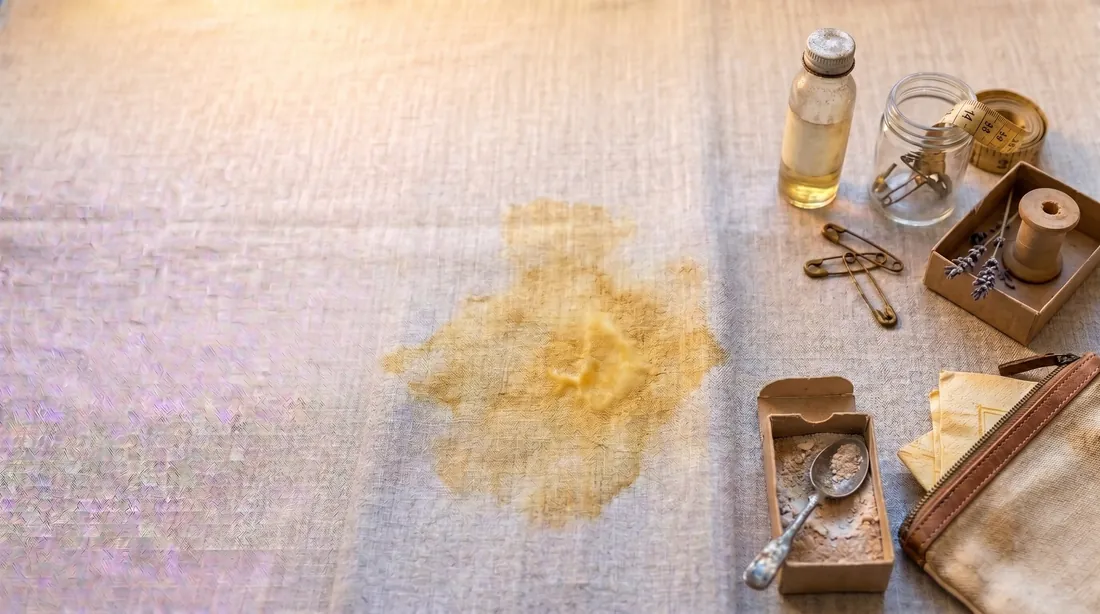
How to remove old yellow storage stains stains
Yellowing on stored textiles comes from detergent residue, oxidized oily soil, fiber aging, and acid transferred from wood, ordinary paper, or cardboard during storage; the older the discoloration, the harder it is to remove. Sturdy everyday washables can be relaundered hot with a water conditioner and, if needed, fabric-safe bleach; fragile or heirloom cotton/linen pieces should only be soaked gently — and valuable or silk/wool items belong with a professional conservator. [1][2][3][4]
First judge the item, not the stain: a sturdy modern washable can be relaundered aggressively, but a very old, fragile, or valuable textile should not be treated at home at all — improper cleaning can permanently damage it. Get the piece out of contact with wood, ordinary cardboard, paper, or plastic bags, which cause and worsen yellowing. [4][2]
Avoid chlorine bleach: it dissolves silk and wool, and on cotton and linen it eventually causes slight yellowing and weakening of its own. Never machine wash a valuable quilt, even on delicate; do not spot-clean heirlooms at home (the solution cannot be fully rinsed out); do not scrub, wring, line-dry, machine-dry, or sun-dry a fragile wet textile. [3][4]
- Water conditioner (for everyday washables)
- Mild liquid hand-dishwashing detergent (for heirloom soaks)
- Distilled or soft water (for heirloom soaks)
- Fiberglass or nylon screen to support wet heirloom textiles
- Fabric-safe bleach (everyday washables only, last resort)
Method
- Identify the fiber and the cause. Yellowing on silk, wool, or spandex is usually fiber aging or past chlorine-bleach damage and is not removable; on other fabrics it is commonly detergent misuse, oily soil washed in cold water, or acid transfer in storage, and can often be corrected. [1][2]
- For everyday washables: wash in the hottest water safe for the fabric using a cup of water conditioner in place of detergent. [1]
- If discoloration persists on washables, re-launder with water conditioner, or with the recommended amounts of detergent plus a bleach that is safe for the fabric. [1]
- Temper expectations on old discoloration: the older the stain, the harder it is to remove, and oxidized residues (such as caramelized sugars or yellowed oils) may have become permanent. [3]
Air-dry and inspect between attempts rather than escalating immediately; repeat gentler treatments before reaching for bleach, and stop if the fabric shows weakening or color change. [1][4]
If that didn't work
If home treatment fails — or the piece is old, fragile, or valuable — take it to a professional: the Smithsonian MCI advises professional handling of old textiles where stain removal risks damage through fabric stress, and UNL directs owners to a professional textile conservator (find one via a museum, university, or the American Institute for Conservation). [3][4]
Cautions
silk, wool, cotton, linen: Chlorine bleach dissolves silk and wool outright, and over time slightly yellows and weakens cotton and linen; it is more damaging than hydrogen peroxide. Hydrogen peroxide is the gentler oxidizer but can still decolorize some dyes and slightly weaken fibers; perborate ('oxygen') bleaches work by releasing hydrogen peroxide and need higher temperatures to activate. [3]
silk, wool: Water itself weakens silk and wool when wet, and many of their dyes are not washfast — airing and careful vacuuming are frequently the only safe home cleaning for wool or silk pieces; wet cleaning them is a conservator's job. [3][4]
silk, wool, spandex: Yellowing on silk, wool, or spandex caused by fiber aging or prior chlorine-bleach use cannot be removed. [1]
whites: Sunlight can turn some white fabrics yellow, and chlorine bleach makes rust stains permanent — if the yellow-brown marks might be rust, do not use chlorine bleach. [1]
Why this works
Aging wood, regular cardboard, and paper give off acid byproducts that harm textiles in contact with them, and plastic bags release harmful byproducts as they decompose while trapping moisture; oxidation also turns residues (oils, sugars) yellow-brown over time, and once oxidized they resist removal methods that work on fresh stains. [2][3]
Heirloom cotton linen
Method
- Test every color and thread for colorfastness first: place several drops of plain water (and then of the detergent solution) on an inconspicuous spot, let soak, and blot with white blotter — repeat several times. If any hint of color transfers, do not wet clean. [4]
- Support the textile on a washed fiberglass or nylon screen and submerge it in a clean bathtub of soft, distilled, or deionized water at room temperature (no more than 90–100°F). Water alone removes considerable soil and the acid byproducts that build up in cotton and linen; change the water whenever it discolors. [4]
- If water alone is not enough, soak at least 30 minutes in about 1 tablespoon of mild liquid hand-dishwashing detergent per 4 gallons of water. Do not use laundry detergents (they contain harsh additives) and do not scrub, squeeze, or beat — gently tamp with your fingers, or press a sponge against a heavily soiled area. [4]
- Rinse five to seven times in distilled water, at least 15 minutes per rinse, until the final rinse water is clear of detergent. [4]
- Lift the piece out supported on the screen (never by one end), lay it flat on plastic sheeting topped with a clean white sheet and towels, press out moisture with more towels, and dry it flat with a fan 3–4 feet away — no clothesline, no direct sun, no machine dryer. [4]
If that didn't work
If soaking does not improve the piece, stop and consult a professional textile conservator rather than escalating; very old, fragile, or valuable textiles should not be cleaned at home at all. [4]
Cautions
cotton, linen, chintz: This soak applies to sturdy cotton or linen only; expect the full process to take roughly 6–8 hours plus drying, and know that wet cleaning may strip glazed finishes such as chintz. A wet quilt is very heavy — work with a helper. [4]
Prevention storage
Method
- Keep textiles out of direct contact with wood (including cedar chests), regular cardboard, and paper — as these age they give off acid byproducts that yellow and harm fabric. Line shelves, boxes, or chests with acid-free tissue or washed unbleached cotton muslin. [2][5]
- Never store textiles in plastic bags or totes: plastics off-gas as they decompose, trap moisture that invites mildew, attract dust, and can even shift dye colors. [2][5]
- Store in the living area of the home — dark, stable temperature and humidity (roughly 68–75°F and 40–57% RH; cooler and ~50% RH for long-term preservation) — never in attics, basements, or other unconditioned spaces. Refold periodically along different lines, wash muslin liners yearly, and replace acid-free tissue about every five years since it turns acidic with age. [5][2]
If that didn't work
If a stored piece shows mold, treat it as an emergency and contact a professional conservator. [5]
Cautions
all textiles: Light — especially direct sunlight — fades dyes and weakens natural fibers; keep stored and displayed textiles out of bright light. [2]
Not covered by our sources
- : Often recommended for storage yellowing, but no source fetched this session gives concentrations or soak times; the closest sourced statements are TAMU's 'bleach safe for the fabric' step and MCI's note that perborate bleaches release hydrogen peroxide.
- : No fetched source covers BHT/phenolic yellowing or its reversal.
- Dry clean only garments: No fetched source gives instructions for yellowed dry-clean-only garments beyond general professional referral.
Where sources disagree
- For yellowed everyday washables, wash in the hottest water safe for the fabric with a cup of water conditioner, then re-launder with detergent and fabric-safe bleach if needed. [1]
- For old or heirloom cotton/linen, never machine wash; use only agitation-free soaks in room-temperature (max 90–100°F) distilled water with mild hand-dishwashing detergent — no laundry detergent, no bleach — and send fragile or valuable pieces to a conservator. [4]
We show both positions rather than silently choosing. When in doubt, follow your care label and the more conservative option.
- If yellowing persists, re-laundering with a bleach that is safe for the fabric is an acceptable final step. [1]
- Chlorine bleach itself eventually yellows and weakens cotton and linen and is more damaging than hydrogen peroxide. [3]
We show both positions rather than silently choosing. When in doubt, follow your care label and the more conservative option.
What people report Anecdotal
Real threads from public forums, linked and labeled. These are individual experiences, not verified results, and never a substitute for the sourced method or safety guidance above.
Blogger Mary Corbet documented trying to whiten an 11-year-old yellowed embroidered linen: boiling with cream of tartar lightened the stain only modestly, while a buttermilk-and-lemon-juice soak lightened the piece considerably.
“Always start with the least aggressive cleaning methods and move to the more aggressive.”
Whitening Yellowed Linens: An Adventure of Sorts — NeedlenThread (embroidery blog), 2020-10-14 · accessed 2026-08-18 · anecdotal
In the follow-up, the author judged a 36-hour buttermilk soak a failure and borax only slightly helpful, but OxiClean White Revive plus a stain remover finally returned the linen to white with only a very faint shadow of the stain remaining.
“After a 36-hour soak, I conceded that buttermilk doesn't really work.”
Yellow to White: Whitening Yellowed Linen, Part II — NeedlenThread (embroidery blog), 2020-10-28 · accessed 2026-08-18 · anecdotal
The poster reported bleach soaks and bleach washes failed on yellowed cotton shorts and a sweat/pit-stained shirt, while one commenter reported removing pit stains from a cotton shirt in about five minutes by dipping the stained area in diluted chlorine bleach, rubbing, and rinsing immediately.
“I did a cotton shirt this morning for pit stains and it took all of 5 min.”
Best way to get yellowing & pit stains out of 100% cotton whites? — r/laundry (Reddit), 2025-05-15 · accessed 2026-08-18 · anecdotal
The poster reported bleach soaks and bleach washes failed on yellowed cotton shorts and a sweat/pit-stained shirt, while one commenter reported removing pit stains from a cotton shirt in about five minutes by dipping the stained area in diluted chlorine bleach, rubbing, and rinsing immediately.
“I did a cotton shirt this morning for pit stains and it took all of 5 min.”
Best way to get yellowing & pit stains out of 100% cotton whites? — r/laundry (Reddit), 2025-05-15 · accessed 2026-08-18 · anecdotal
Sources
- Institutional Texas A&M AgriLife Extension — Removing Stains from Washable Fabrics (accessed 2026-08-18)
- Institutional University of Nebraska-Lincoln Extension — Care of Quilts: Storage and Display (NebGuide G1820) (accessed 2026-08-18)
- Institutional Smithsonian Museum Conservation Institute — Stain Removal (accessed 2026-08-18)
- Institutional University of Nebraska-Lincoln Extension — Care of Quilts: Cleaning (NebGuide G1821) (accessed 2026-08-18)
- Institutional Museum of the Albemarle (North Carolina Division of State History Museums) — How to Care for Your Textiles (accessed 2026-08-18)
Updated 2026-08-18. Compiled from the cited sources; not independently verified by this site. Spotted an error? See the corrections policy.