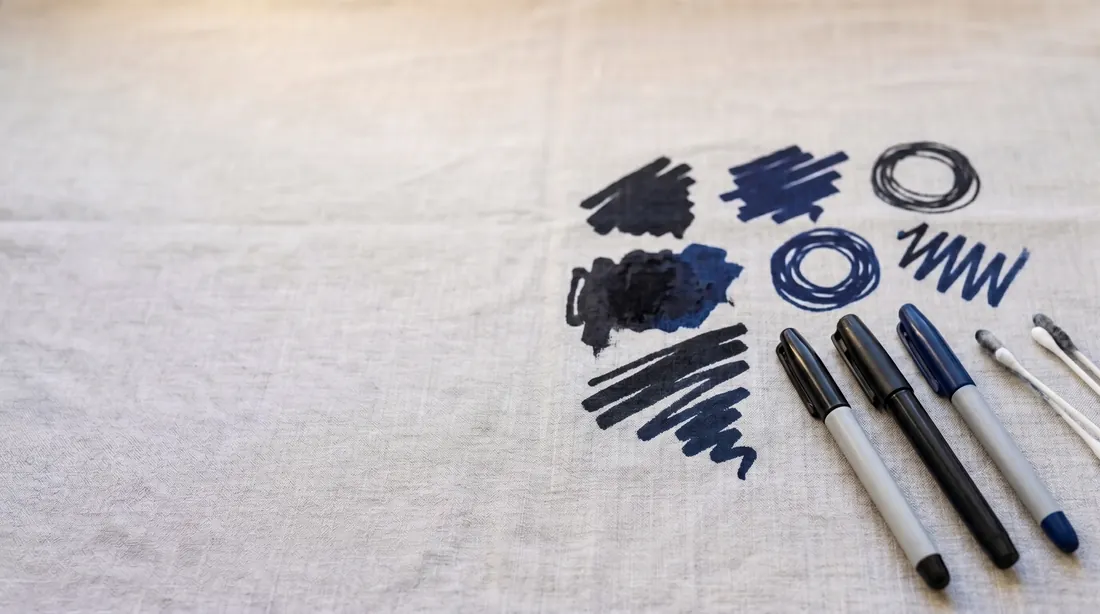
How to remove permanent marker stains
Permanent (felt-tip) marker is one of the hardest stains — UGA warns permanent inks are almost impossible to remove — so temper expectations and treat immediately. On washable fabric, sponge continuously with acetone, rubbing alcohol, or a pre-wash remover until the ink stops bleeding, then launder; Texas A&M's route is cool water and wet spotter, then detergent laundering with ammonia, bleach, or color remover for what remains. [1][2]
- Rubbing alcohol, acetone, or pre-wash stain remover
- Clean absorbent pads
- Liquid dishwashing detergent (for wet spotter)
- Glycerin (for wet spotter)
- Household ammonia
- Heavy-duty liquid laundry detergent
Method
- Place the stain face-down over an absorbent pad and sponge continuously from the back with acetone, rubbing alcohol, or a pre-wash remover until the ink stops bleeding out; let dry and repeat if needed. [1]
- Alternatively (or next), flush with cool water and work in wet spotter — 1 part glycerin, 1 part liquid detergent, 8 parts water — sponging or tamping gently, then flush with cool water; repeat while the stain keeps lifting. [2]
- Work heavy-duty liquid detergent into the stain and launder in warm water; inspect before drying. [2]
- If the stain remains, apply wet spotter with a few drops of ammonia, sponge or tamp, and flush; then, if the fabric allows, soak in dilute all-fabric (oxygen) bleach, or for whites/colorfast items 15 minutes in dilute chlorine bleach. [2]
Air-dry and inspect before machine drying or ironing: heat sets any remaining marker permanently. Stop treatment as soon as the stain is gone. [2]
If that didn't work
Try a dedicated remover such as Amodex — applied to the dry stain, rubbed in well with a stiff brush or fingernail, left up to 1-12 hours, then laundered. On whites, the last resort is a dye/color remover, which strips all fabric color. Otherwise take it to a professional cleaner. [3][2]
Cautions
Expect partial results: permanent inks are almost impossible to remove. [1]
acetate, triacetate, modacrylic: Acetone and acetone nail-polish remover destroy acetate, triacetate, and modacrylic fabrics. [1][2]
acetate, triacetate, modacrylic, acrylic, silk, wool: Alcohol damages acetate, triacetate, modacrylic, and acrylic fibers (dilute 2 parts water on acetate); ammonia damages silk and wool (dilute with equal water, use sparingly). Pretest every remover on a hidden area. [1][4]
Never mix removers, especially ammonia with chlorine bleach — the fumes are highly toxic; rinse thoroughly between treatments and work with good ventilation away from flames. [2][4]
Carpet & rugs
Method
- Apply a household multipurpose cleaner (e.g., 409 or Fantastic) and blot; sponge with water and blot again. Never rub marker ink on carpet. [1]
- If it remains, try full-strength white vinegar followed by the multipurpose cleaner, blotting; then 1 part clear ammonia to 4 parts water, agitated lightly with a toothbrush, blotted, and rinsed with clear water. [1]
- Lay 1/2-inch absorbent pads on the area weighted with books for several hours, then remove, rub the pile against the nap to reset it, and air-dry thoroughly. [1]
If that didn't work
Professional cleaning if the stain persists. [1]
Cautions
Permanent inks on carpet are almost impossible to remove; fur cannot be treated at home. [1]
Walls painted
Method
Plastic
Method
- Apply a thin coat of Amodex and leave it several hours or overnight to draw embedded ink out of porous plastic, then wipe clean. [3]
Leather & suede
Method
- Apply a small amount of Amodex and scrape gently with a fingernail — no sharp tools — then wipe clean with a damp rag; pretest a hidden spot first. [3]
Cautions
Ink on leather can act on the hide immediately, and there is no guaranteed way to remove it once contact is made. [1]
Not covered by our sources
- Suede: No fetched source gives a marker-specific method for suede; MSU advises against attempting major home stain removal on suede garments. Refer to a professional.
Where sources disagree
- Sponge felt-tip/permanent ink with acetone, rubbing alcohol, or a pre-wash remover until bleeding stops (UGA), or start with a cool-water/wet-spotter wet treatment (Texas A&M). [1][2]
- Never wet the stain first and do not use alcohol or hairspray — the manufacturer states water/detergent can permanently set stains and alcohol worsens ink marks; apply Amodex to the dry stain. [3]
We show both positions rather than silently choosing. When in doubt, follow your care label and the more conservative option.
What people report Anecdotal
Real threads from public forums, linked and labeled. These are individual experiences, not verified results, and never a substitute for the sourced method or safety guidance above.
A poster reported that treating permanent marker with a specialist pen/felt-tip remover (Dr Beckmann or Stain Devil) before washing removes about 95% of it, while posters agreed that once the item has been washed the mark is nearly impossible to remove.
“If you treat it with specialist pen/biro/felt tip remover before you wash it then it gets 95% of it off.”
Is it possible to get permanent marker out of clothes? — Mumsnet, 2010-04-28 · accessed 2026-08-18 · anecdotal
Sources
- Institutional University of Georgia Extension — Remove Stains from Ink (Ballpoint, Felt Tip, India, Mimeo, Stamp Pad) (accessed 2026-08-18)
- Institutional Texas A&M AgriLife Extension — Removing Stains from Washable Fabrics (accessed 2026-08-18)
- Manufacturer Amodex Products — Stain Solutions / FAQ — Amodex Ink & Stain Remover (accessed 2026-08-18)
- Institutional Michigan State University Cooperative Extension Service — Stain Out — A General Guide to Stain Removal (Extension Bulletin E-1453) (accessed 2026-08-18)
Updated 2026-08-18. Compiled from the cited sources; not independently verified by this site. Spotted an error? See the corrections policy.