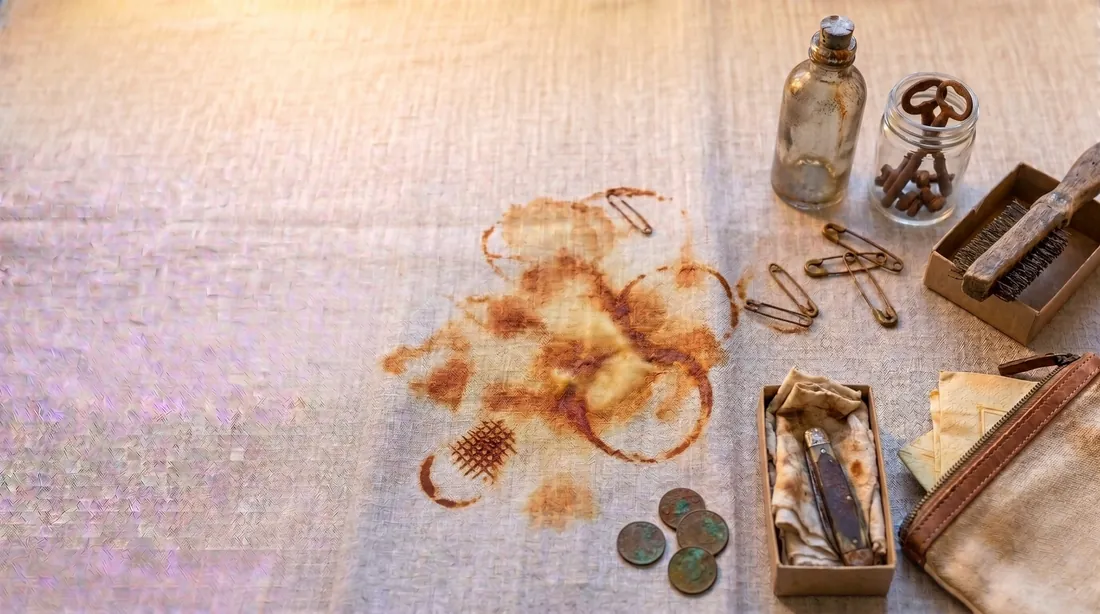
How to remove rust stains
Never bleach a rust stain: both UGA and Texas A&M warn chlorine bleach sets rust permanently. On washable fabric start gentle — salt sprinkled on the stain with lemon juice, dried in the sun — then, if the fabric can be boiled, a cream-of-tartar boil (4 teaspoons per pint of water), and finally a commercial rust remover used exactly per its label after pretesting. Sources disagree on hydrofluoric-acid removers: Texas A&M says do not use them at all. [1][2]
- Salt and lemon juice
- Cream of tartar (for boil-safe fabrics)
- Commercial rust remover (hardware store) — pretest first
- Oxygen bleach or a commercial color remover (for whites)
- Rubber gloves
Method
- Sprinkle salt on the stain, squeeze lemon juice over it, and spread the fabric in the sun to dry; rinse and repeat if needed. [1][2]
- If the fabric is safe to boil (generally some cottons and linens), boil the stained article in a solution of 4 teaspoons cream of tartar per pint of water until the discoloration lifts, then rinse thoroughly. [1]
- If the stain resists, apply a commercial rust remover following the manufacturer's directions exactly, on white and colorfast fabrics only, after testing for color change on a hidden area. [1][2]
- For whites, add one cup of oxygen bleach to the detergent and soak 10-15 minutes, or use a commercial color remover from a grocery or drug store. [1]
Inspect before any machine drying or pressing — heat sets stains, and a set rust mark plus dryer heat is much harder to shift. Repeat the gentler steps before escalating to acid removers. [2]
If that didn't work
Repeat treatment after drying, escalate to a commercial rust/iron remover per its label, or — for upholstery and leather — hand the item to a professional cleaner, since UGA classes rust as a chemical stain for professionals on those surfaces. [1]
Cautions
Do not use chlorine bleach on rust: it will set the stain and make it permanent. [1][2]
Texas A&M warns: do not use rust removers containing hydrofluoric acid — they are extremely toxic and can burn the skin. Oxalic-acid removers (e.g., Zud, RoVer) may change the color of some dyes; avoid skin contact. [2]
Oxalic acid is poisonous: do not let it touch skin, and wear rubber gloves. [1]
Whink Rust Stain Remover contains hydrofluoric acid — handle any such product strictly by its label. (Detailed label warnings could not be fetched this session.) [3]
Peracetic acid (heavy exterior brick stains) demands protection for eyes and hands, and the fumes must not be breathed. Provide ventilation for any caustic solution and keep all products away from children. [1]
Never mix stain removers, especially ammonia and bleach — mixtures produce toxic fumes. [2]
Carpet & rugs
Method
- Mix 1 tablespoon oxalic acid into 1 cup of warm water and apply with a toothbrush using light agitation, wearing rubber gloves. [1]
- If the stain persists, let the area dry and repeat; then try a commercial rust/iron remover, pretesting an inconspicuous spot. [1]
Cautions
Oxalic acid is poisonous — no skin contact, rubber gloves, good ventilation. [1]
Upholstery & mattresses
Method
- Do not treat at home: iron and rust are chemical stains that should be handled by a professional cleaner (this applies to leather as well). [1]
Tile ceramic
Method
- Scrub with a heavy-duty cleaner containing a large amount of trisodium phosphate (TSP), such as Spic 'n Span, until the stain is removed. [1]
- If needed, use an oxalic-acid remover such as Zud, or Barkeeper's Friend, per label directions. [1]
- For set stains, dissolve oxalic acid crystals in hot water, mix with whiting or talcum powder into a soft paste, apply as a poultice, let dry, remove, and rinse. On walls, a borax-and-lemon-juice paste rubbed in, dried, and rinsed is another option. [1]
Cautions
Oxalic acid is poisonous — wear rubber gloves and keep it off skin. [1]
Marble
Method
- Rub with a mild cleanser such as baking soda on a felt pad and wash thoroughly. [1]
- If it persists, make a paste of powdered whiting or chalk dust with a commercial liquid rust remover, cover with plastic wrap sealed with masking tape, let stand for hours, sponge off, and buff; follow with the same poultice made with 6% hydrogen peroxide. [1]
- If the surface has dulled, polish with tin-oxide marble polishing powder and buff. [1]
Not covered by our sources
- Leather & suede: No home method in any fetched source; UGA directs rust on leather (with upholstery) to a professional cleaner.
Where sources disagree
- Do not use rust removers containing hydrofluoric acid — they are extremely toxic and can burn the skin. [2]
- The maker of Whink Rust Stain Remover, which contains hydrofluoric acid, markets it as safely removing rust stains from colorfast fabrics, carpet, white sinks, and toilet bowls. [3]
We show both positions rather than silently choosing. When in doubt, follow your care label and the more conservative option.
What people report Anecdotal
Real threads from public forums, linked and labeled. These are individual experiences, not verified results, and never a substitute for the sourced method or safety guidance above.
One poster reported firsthand that a supermarket Stain Devils product for rust removed the stain, while other remedies in the thread (lemon juice and salt, cream of tartar, rhubarb water) were quoted from a hints book without personal testing.
“Got some Stain Devils for rust (from the supermarket) and it worked 'like magic'.”
rust stains — MoneySavingExpert Forum, 2004-11-12 · accessed 2026-08-18 · anecdotal
The poster reported bleach, vinegar, and a strong stain remover all failed on a patchy stain on white pants; commenters identified it as likely rust, and one reported having great success with Whink rust remover, cautioning that chlorine bleach can permanently set iron stains.
“If Carbona Rust Stain Remover doesn’t work, I’d try Whink—I’ve had great success with it.”
how to get stubborn stain out of white pants — r/laundry (Reddit), 2025-03-30 · accessed 2026-08-18 · anecdotal
Sources
- Institutional University of Georgia Extension — Remove Stains from Iron, Rust (accessed 2026-08-18)
- Institutional Texas A&M AgriLife Extension — Removing Stains from Washable Fabrics (accessed 2026-08-18)
- Manufacturer Whink / Rust-Oleum (manufacturer description on Hemlock Hardware retail listing) — Whink 32 Oz. Rust Stain Remover (product listing) (accessed 2026-08-18)
Updated 2026-08-18. Compiled from the cited sources; not independently verified by this site. Spotted an error? See the corrections policy.