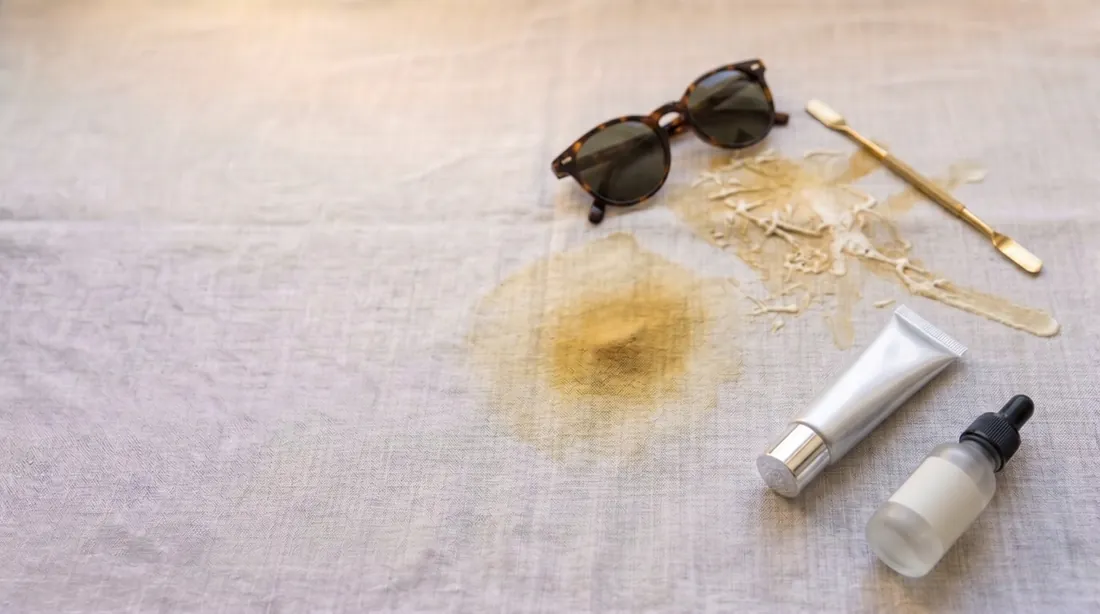
How to remove sunscreen stains
Sunscreen leaves an oily lotion stain, and sunscreens containing avobenzone can also react with iron in hard water to leave orange, rust-like marks that appear in the wash. Blot excess, rinse in cold water, pretreat with liquid detergent (or an aerosol pre-wash remover), and wash in the hottest water the care label allows. Recheck before drying — heat sets the stain — and treat rust-colored avobenzone marks like rust, not like dirt. [1][2][3]
- Paper towels or cloth for blotting
- Liquid laundry detergent or dish soap
- Pre-wash stain remover (aerosol)
- Rust remover or lemon juice and salt (for orange avobenzone marks)
Method
- Brush or blot off excess sunscreen without rubbing, then rinse the stained area under cold running water. [1][2]
- Pretreat: work liquid detergent into the stain with a soft toothbrush or by rubbing the fabric together and let it sit about five minutes — or saturate with an aerosol pre-wash stain remover (aerosols work better on greasy stains) and rub in heavy-duty liquid detergent for stubborn spots. Liquid dish soap also cuts the oils. [1][3][2]
- Wash immediately on the usual cycle at the hottest temperature the care label allows. [1][3]
- Unload promptly, air-dry, and check the stain; repeat the earlier steps if any mark remains before the item ever sees a dryer. [1][2]
Inspect while the garment is still damp: if any greasy shadow or orange tint remains, repeat treatment before machine drying, because drying will set the stain. [1]
If that didn't work
For an orange or rust-colored avobenzone mark, treat it as a rust stain: pretreat with lemon juice and table salt or a commercial rust remover, then relaunder. For heavy oily residue, apply dry-cleaning solvent to the back of the stain over absorbent paper towels, let dry, rinse, and repeat the wash routine; rubbing alcohol helps with titanium-dioxide marks. [2][3]
Cautions
all fabrics, synthetics: Check the care label before washing hot, and if using a chlorine-bleach soak (per Illinois), test bleach tolerance on a hidden seam first and stop after 15 minutes; keep wash water below 160°F for synthetics. [1][3]
synthetics: Synthetic fabrics pick up avobenzone rust staining more readily than natural fibers like cotton, and the severity depends on how much iron is in your water. [1]
all fabrics: Prevention beats removal: let sunscreen dry on your skin before dressing, and in hard-water areas check ingredient lists and consider avoiding avobenzone sunscreens. [1]
Why this works
Avobenzone, a UV filter in many sunscreens, reacts with iron in hard water — Iowa State describes the ingredients oxidizing with minerals in the water — producing yellowish-to-orange rust-colored stains that typically show up after washing rather than when the garment is worn. [1][2]
Washable fabric dye residue
Method
- If color persists after the oily component is out, treat the remainder as a dye stain: soak in a diluted all-fabric powdered bleach solution. [3]
- For white or colorfast garments only, soak in diluted liquid chlorine bleach — check bleach tolerance on a hidden seam first and give up after 15 minutes if it isn't working. [3]
- If bleaching is unsuitable, use a commercial color remover, keeping water below 160°F for synthetics. [3]
If that didn't work
UGA's suntan-lotion routine is an alternative: soak 15 minutes in 1 quart warm water with 1/2 teaspoon liquid dishwashing detergent and 1 tablespoon white vinegar, rinse and sponge, then soak 30 minutes in 1 quart warm water with 1 tablespoon sodium perborate bleach, and finish with a pre-wash soil remover. [4]
Cautions
all fabrics: Iowa State disputes this bleach route for sunscreen stains — see the conflicts entry before reaching for bleach. [2][3]
Not covered by our sources
- Carpet & rugs: No fetched source gives sunscreen-specific steps for carpet; UGA's carpet cosmetics list does not include suntan lotion.
- Leather & suede: Iowa State mentions blotting sunscreen on leather and following leather-specific directions by severity, but no fetched source provides the actual leather steps.
Where sources disagree
- Use bleach for remaining color: soak/wash in fabric-safe chlorine bleach or oxygen bleach (Illinois), or soak in a sodium perborate bleach solution for 30 minutes (UGA). [3][4]
- Avoid soaking the garment and avoid bleach or oxygen-bleach products — they are ineffective on sunscreen stains or make them worse; use rust removers, lemon juice and salt, or dish soap instead. [2]
We show both positions rather than silently choosing. When in doubt, follow your care label and the more conservative option.
What people report Anecdotal
Real threads from public forums, linked and labeled. These are individual experiences, not verified results, and never a substitute for the sourced method or safety guidance above.
Posters reported firsthand successes on yellow suncream marks with a sticky-stuff-remover soak followed by two washes, liberal white vinegar spray before washing, Stain Devils oily-stain remover, SMOL stain remover, and an OxyWhite soak.
“I spray the yellow stains liberally, then wash and it's usually gone.”
Suncream has stained white clothes — Mumsnet, 2024-08-02 · accessed 2026-08-18 · anecdotal
Sources
- Manufacturer Tide (Procter & Gamble) — How to Remove Sunscreen Stains (accessed 2026-08-18)
- Institutional Iowa State University Extension and Outreach — Sunscreen Stains (AnswerLine) (accessed 2026-08-18)
- Institutional University of Illinois Extension — Suntan Lotion (oil based) — Stain Solutions (accessed 2026-08-18)
- Institutional University of Georgia Extension — Remove Stains from Cosmetics (Makeup, Sunscreen) (accessed 2026-08-18)
Updated 2026-08-18. Compiled from the cited sources; not independently verified by this site. Spotted an error? See the corrections policy.