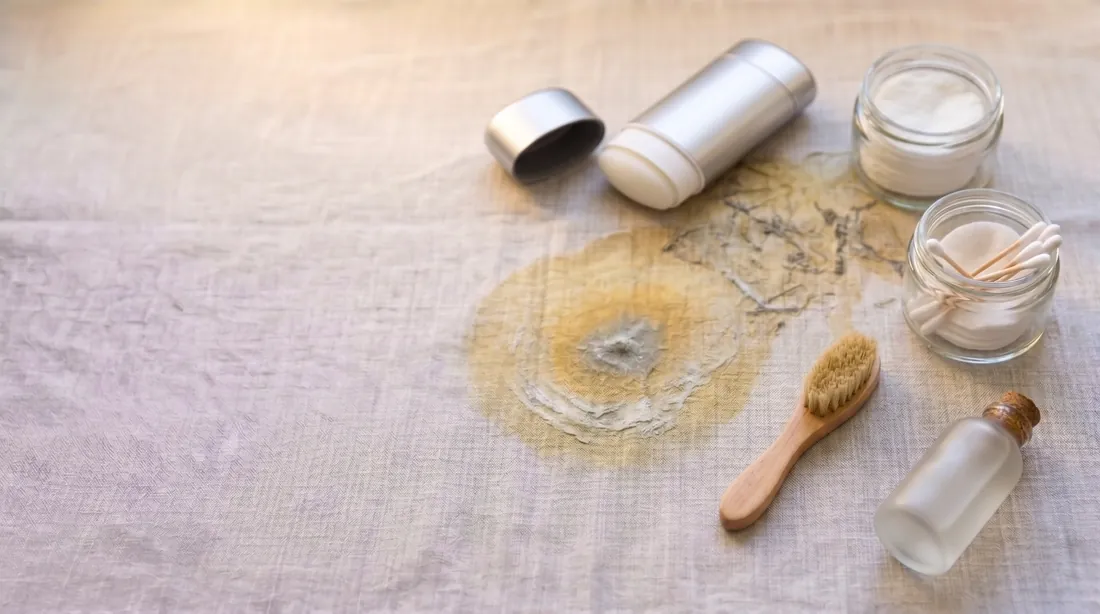
How to remove sweat & deodorant stains
For perspiration, soak the garment 15–30 minutes in warm water with a sodium perborate (oxygen) bleach, then launder in the hottest water the care label allows; an oxygen-product soak of one to six hours also works. Restore changed color with a few drops of ammonia (fresh stains) or white vinegar (old ones). For deodorant marks, rub in undiluted dishwashing liquid before laundering — and never iron or heat a deodorant stain. [1][2][3]
- Sodium perborate (oxygen) bleach or oxygen stain-remover powder
- Liquid or hand dishwashing detergent
- Household ammonia
- White vinegar
- 3% hydrogen peroxide (optional)
- Table salt (for odor soak)
Method
- Soak the garment for 15–30 minutes in warm water containing sodium perborate bleach. Alternatively, dissolve an oxygen stain-remover powder in a gallon of the warmest water the fabric allows and soak for 1–6 hours. [1][2]
- If perspiration has changed the fabric color, apply a few drops of ammonia to a fresh stain or a few drops of white vinegar to an old one, then rinse. [1]
- For a deodorant or antiperspirant mark, rub undiluted hand dishwashing liquid into the stain, or pretreat with a paste of oxygen powder detergent and warm water for about five minutes. [3][4]
- Launder in the hottest water that is safe for the fabric, with bleach if the care label permits, leaving the pretreatment on the stain. [1][4]
- For lingering odor, soak overnight in warm salt water (3–4 tablespoons of salt per quart), rinse, and if odor persists pre-treat with liquid detergent for 30 minutes before rewashing. [1]
Inspect the underarm area after washing and before drying. If any stain remains, repeat the pretreatment and wash again — dryer heat sets deodorant stains. [4]
If that didn't work
For stubborn perspiration stains, apply 3% hydrogen peroxide for 15–20 minutes and repeat two or three times if needed. A persistent deodorant stain can be treated with chlorine or sodium perborate bleach, hydrogen peroxide, or a petroleum-distillate spot remover used with gloves and ventilation. [1][3]
Cautions
Never iron or apply heat to a deodorant stain — heat plus deodorant damages most fabrics. [3]
silk, wool: Ammonia damages silk and wool; if you must use it on these fibers, dilute it with an equal amount of water. [1]
silk, wool, leather, dry-clean-only: Oxygen stain-remover soaks are not for silk, silk blends, wool, wool blends, leather, or anything labeled dry-clean-only. [2]
cotton, linen: Dilute white vinegar with two parts water before using it on cotton or linen. [3]
Petroleum-distillate spot removers are highly toxic and often flammable — pretest, wear rubber gloves, ventilate, and keep containers tightly closed. [3]
Carpet deodorant
Method
- Apply rubbing alcohol to the deodorant stain and cover with an absorbent pad dampened with alcohol. Keep it moist until no more stain lifts. [3]
- As a last resort, flush with a solution of 3/4 cup warm sudsy water plus 1 tablespoon ammonia, then rinse with clear water. [3]
- Apply warm water with white vinegar, rinse again, and dry thoroughly. If the carpet color changed, sponge lightly with 2 parts water to 1 part ammonia. [3]
If that didn't work
Repeat the alcohol-pad treatment before escalating to the sudsy-ammonia flush and vinegar rinse. [3]
Cautions
acetate, triacetate, modacrylic, acrylic, silk, wool: Alcohol damages acetate, triacetate, modacrylic, and acrylic fibers; ammonia damages silk and wool (dilute with equal water if unavoidable). [3]
Upholstery cotton linen synthetics
Method
- Spray the perspiration stain lightly with a commercial laundry prewash and blot with a white cloth. [1]
- Sponge with mild dishwashing detergent and water, rinse with clear water, and air-dry quickly. [1]
- For old stains, sponge with a diluted white vinegar solution, then rinse with clear water. [1]
If that didn't work
Repeat the prewash-and-detergent sponging cycle until no more stain transfers to the blotting cloth. [1]
Cautions
Pretest the cleaning agents and avoid overwetting, which can migrate the fabric finish; dilute vinegar 1:2 with water for cotton and linen. [1]
Upholstery silk wool synthetic vinyl
Method
- Dip an absorbent cloth in warm sudsy water with a few drops of ammonia and wring it nearly dry. [1]
- Sponge the stained area well while blotting with clear water. [1]
- If needed, keep working the spot with an absorbent cloth blotter moistened with the same solution. [1]
If that didn't work
Repeat the sponge-and-blot cycle with the diluted solution; the fetched source gives no stronger method for these fibers. [1]
Cautions
silk, wool: Ammonia damages silk and wool — dilute it with an equal amount of water on these fibers — and avoid overwetting the upholstery. [1]
Leather upholstery
Method
- Mix mild soap in lukewarm water and work up suds. [3]
- Apply only the foam with a sponge to the deodorant mark. [3]
- Wipe dry and follow with saddle soap. [3]
If that didn't work
Repeat the foam-only cleaning; no stronger fetched-source method exists for leather. [3]
Cautions
leather: Use the foam only, not the liquid, on leather. [3]
Not covered by our sources
- Hats structured: OxiClean gives a soak routine for hats generally, but no fetched source addresses structured/brimmed hats that cannot be submerged.
Where sources disagree
- Never iron or apply heat to material with a deodorant stain — the combination damages most fabrics. [3]
- After pretreating with an oxygen-powder paste, wash the deodorant-stained garment at the hottest wash temperature the care label permits. [4]
We show both positions rather than silently choosing. When in doubt, follow your care label and the more conservative option.
What people report Anecdotal
Real threads from public forums, linked and labeled. These are individual experiences, not verified results, and never a substitute for the sourced method or safety guidance above.
The poster reported bleach soaks and bleach washes failed on yellowed cotton shorts and a sweat/pit-stained shirt, while one commenter reported removing pit stains from a cotton shirt in about five minutes by dipping the stained area in diluted chlorine bleach, rubbing, and rinsing immediately.
“I did a cotton shirt this morning for pit stains and it took all of 5 min.”
Best way to get yellowing & pit stains out of 100% cotton whites? — r/laundry (Reddit), 2025-05-15 · accessed 2026-08-18 · anecdotal
Reports were mixed: two posters said sunshine, bleach, aspirin, bicarb, lemon, Vanish, and hot washes all failed on yellow armpit stains, while one had some luck with ammonia and another said Dr Beckmann sweat stain remover works well.
“I've tried absolutely everything suggested on the Internet and have yet to find a solution.”
Yellow armpit stains — Mumsnet, 2020-09-30 · accessed 2026-08-18 · anecdotal
The poster reported bleach soaks and bleach washes failed on yellowed cotton shorts and a sweat/pit-stained shirt, while one commenter reported removing pit stains from a cotton shirt in about five minutes by dipping the stained area in diluted chlorine bleach, rubbing, and rinsing immediately.
“I did a cotton shirt this morning for pit stains and it took all of 5 min.”
Best way to get yellowing & pit stains out of 100% cotton whites? — r/laundry (Reddit), 2025-05-15 · accessed 2026-08-18 · anecdotal
Sources
- Institutional University of Georgia Extension — Remove Stains From Perspiration (accessed 2026-08-18)
- Manufacturer OxiClean (Church & Dwight) — How to Remove Sweat Stains and Odors from Clothing (accessed 2026-08-18)
- Institutional University of Georgia Extension — Remove Stains From Antiperspirant, Deodorant (accessed 2026-08-18)
- Manufacturer Tide (Procter & Gamble) — How to Remove Deodorant Stains (accessed 2026-08-18)
Updated 2026-08-18. Compiled from the cited sources; not independently verified by this site. Spotted an error? See the corrections policy.