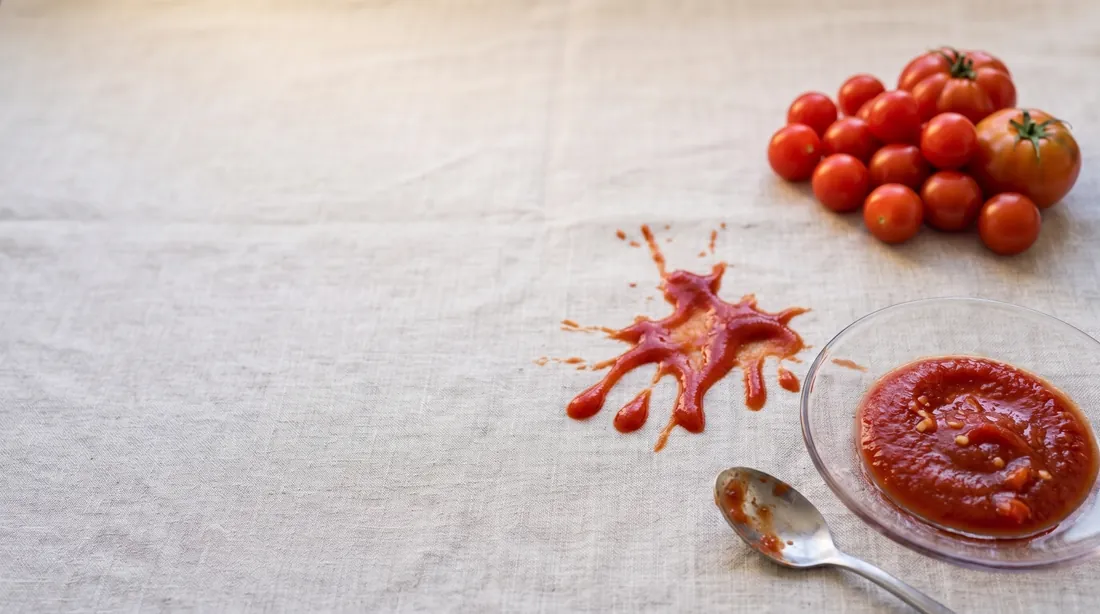
How to remove tomato & ketchup stains
Scrape off the excess, then treat washables with a pre-wash spot remover or rub in liquid laundry detergent and wash in warm or hot water if the fabric allows. Oily tomato sauces need the greasy portion removed first (solvent or stain stick) before detergent and washing. Colored fabrics with a lingering mark can soak in a color-safe enzyme pre-soak; confirm the stain is gone before machine drying. [1][2][3]
- Dull knife or spoon (to scrape)
- Cool water
- Commercial pre-wash spot remover
- Heavy-duty liquid laundry detergent
- Enzyme pre-soak product
- Sodium perborate (oxygen) bleach for sauce stains
Method
- Scrape off any excess, then apply a commercial pre-wash spot remover following the manufacturer's directions, or rub liquid laundry detergent into the stain. [1][2]
- Wash with heavy-duty liquid detergent in warm or hot water if that is safe for the fabric. [1][2]
- If the stain remains on colored fabric, soak it in a color-safe enzyme pre-soak product and rewash. [2]
Verify the stain is fully removed before the item goes into the machine dryer; repeat pretreatment and washing if any trace remains. [2][3]
If that didn't work
For oily barbecue or spaghetti sauce, treat it as a combination stain: remove the greasy portion first by sponging with a petroleum-distillate cleaner over an absorbent pad (or use a dry-cleaning solvent/stain stick), then work in liquid dishwashing detergent with a few drops of ammonia, flush the ammonia out thoroughly with water, soak 30 minutes in 1 quart warm water with 1 tablespoon sodium perborate bleach, and launder with heavy-duty detergent. [1][3]
Cautions
Read the care label before treating, pretest cleaners on an inconspicuous spot for colorfastness, and never use a product the label prohibits. [1]
Solvent-based cleaners and ammonia need good ventilation and no open flames; wear rubber gloves, store products away from children, and flush ammonia out of fabric thoroughly. [1]
cotton, linen, acetate, triacetate, modacrylic, acrylic: Dilute vinegar with 2 parts water before using it on cotton or linen, and note that rubbing alcohol damages acetate, triacetate, modacrylic, and acrylic fibers. [1]
Carpet & rugs
Method
- Sponge the spot with cool water, then spray it with a combination solvent such as Spray 'n Wash and agitate lightly with a toothbrush. [1]
- Cover with an absorbent pad and blot, then rinse with cool water and blot again. [1]
- If the stain remains, sponge with a 1:1 solution of vinegar and water, blot with a clean pad, rinse with clear water, and blot with a rotating pad; once the stain is gone, weight a half-inch layer of absorbent pads over the area with books for several hours. [1]
If that didn't work
For a persistent spot, wearing rubber gloves, mix 2 tablespoons oxalic acid, 1 tablespoon white vinegar, and 8 tablespoons glycerin, stirring in butyl alcohol until the mixture clears; apply briefly, blot it up, flush with clear water, blot, and finish with the weighted-pad procedure. [1]
Cautions
Tomato can stain carpet permanently — treat it immediately and pretest cleaners on a hidden area. [1]
Upholstery & mattresses
Method
- Sponge the stain with cool water, then spray with a combination solvent such as Spray 'n Wash and agitate lightly. [1]
- Cover with an absorbent pad, blotting and rotating the pad as the stain lifts, then rinse with cool water and blot again. [1]
- If the stain remains, sponge with a 1:1 vinegar-and-water solution, blot with a clean pad, rinse with clear water, blot with a rotating pad, and let the fabric dry. [1]
If that didn't work
Repeat the solvent-then-vinegar sequence, blotting between rounds, rather than escalating to harsher chemicals on upholstery fabric. [1]
Cautions
Over-wetting upholstery can make the fabric finish migrate and leave visible circles — use as little liquid as possible. [1]
Wallpaper
Method
- Immediately sponge or gently scrape off the excess — tomato will often permanently stain wallpaper. [1]
- Wipe with a damp sponge or cloth using overlapping strokes, then pat dry gently. [1]
- If a mark persists, try a commercial wallpaper cleaner. [1]
If that didn't work
Use a commercial wallpaper cleaner as the last resort the source offers for wallpaper. [1]
Cautions
Expect that a set tomato stain on wallpaper may not come out — the surface stains permanently in many cases. [1]
Not covered by our sources
- Leather & suede: No source fetched this session covers tomato or ketchup on leather; UGA's upholstery section addresses fiber upholstery only. Refer to a leather-care professional.
Third-party tests Not our test
Cubby (via AOL): The author deliberately stained a white crib sheet with baby poop, ketchup, chocolate, coffee, and mud, then treated sections with five products: Amodex, Tide To Go pen, Puracy stain remover, Zote soap bar, and Miss Mouth's Messy Eater.
Puracy removed all stains except barely visible traces of mud and chocolate and was named the winner, with results improving with longer dwell time; Miss Mouth's performed similarly; Zote and Amodex ranked worst in this test.
I Tested 5 Stain Removers and There Was One Runaway Winner (I'm Never Without It Now) · 2025-09-17 · accessed 2026-08-18 · third-party test — not our test
What people report Anecdotal
Real threads from public forums, linked and labeled. These are individual experiences, not verified results, and never a substitute for the sourced method or safety guidance above.
Multiple posters reported firsthand that hanging tomato-stained clothes in the sun removed the stains, with one initially skeptical poster confirming it worked and another noting it works even without bright sunshine.
“I was very dubious but found that hanging clothes in the sun really worked!”
Getting tomato sauce stains out of clothes — Mumsnet, 2012-07-31 · accessed 2026-08-18 · anecdotal
Sources
- Institutional University of Georgia Extension — Remove Stains From Ketchup, Tomato, Tomato-based Sauces/Juices (accessed 2026-08-18)
- Institutional Iowa State University Extension and Outreach — Summer Food Stain Removal (AnswerLine) (accessed 2026-08-18)
- Institutional Iowa State University Extension and Outreach — Holiday Stains (AnswerLine) (accessed 2026-08-18)
Updated 2026-08-18. Compiled from the cited sources; not independently verified by this site. Spotted an error? See the corrections policy.