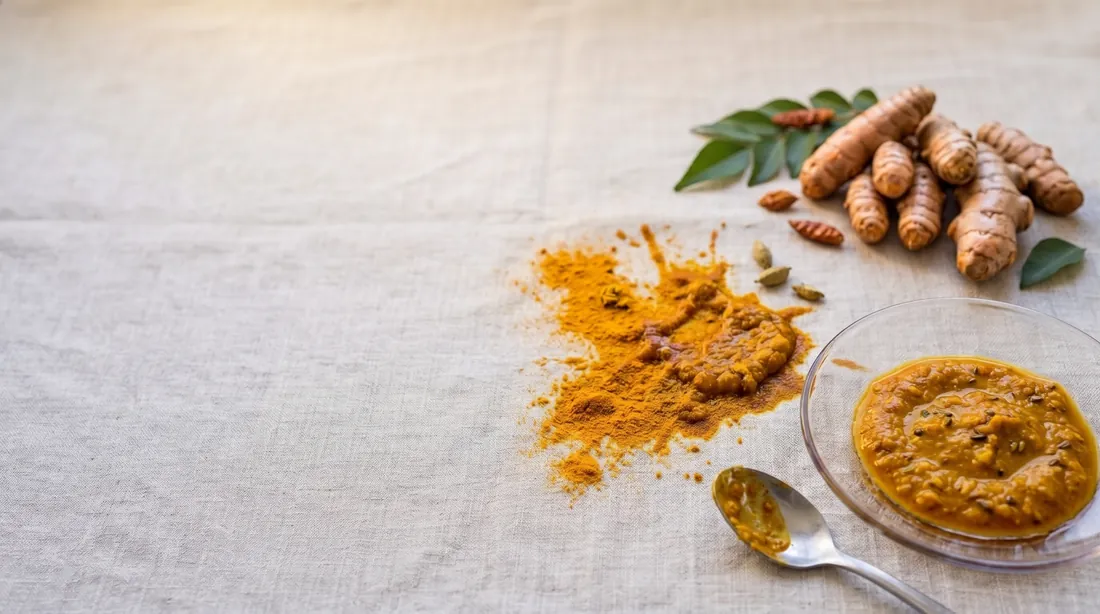
How to remove turmeric & curry stains
Curry stains come from vibrant ingredients including turmeric, chilli powder, tomato, and oil — and turmeric is the same yellow dye that makes mustard so stubborn. Scrape off the residue, pre-treat with an oxygen-bleach stain remover powder mixed to a paste, wash with detergent plus a scoop of the powder, and soak (max 40°C) if the mark survives. Treat immediately: a set turmeric stain can be impossible to remove. [1][2][3]
- Dull knife or spoon (to scrape)
- Oxygen-bleach stain remover powder (e.g., Vanish Oxi Action)
- Regular laundry detergent
- Warm or cold water (max 40°C for soaking)
- Light-duty liquid detergent, white vinegar, and 3% hydrogen peroxide (alternative route)
Method
- Scrape off as much of the curry or turmeric residue as possible with a dull knife or spoon. [1]
- Pre-treat: mix about 10 g of oxygen-bleach powder with an equal amount of water, stir for 30 seconds, apply the paste to the stain, and rub it in as needed. [1]
- Wash as usual with your normal detergent plus a scoop of the oxygen-bleach powder in the load. [1]
- If the stain is still visible, soak the garment in a scoop of the powder dissolved in 4 liters of warm or cold water (no hotter than 40°C) — up to 1 hour for colored clothes or up to 6 hours for whites — then wash again with detergent and an extra scoop. [1]
Always check that the stain has vanished before the item goes in the dryer — heat-drying sets the stain and can make it permanent. [1][3]
If that didn't work
For mustard stains — whose yellow component is turmeric — UGA's washable-fabric route is: scrape off the excess, sponge with a petroleum-distillate commercial cleaner or apply a pre-wash stain remover, rinse, work in light-duty liquid detergent with a few drops of vinegar, rinse well, and if the yellow remains, apply 3% hydrogen peroxide, rinse, and launder. [2]
Cautions
wool, silk, leather: Do not use the oxygen-bleach soak powder on wool, silk, or leather, follow the packaging instructions, and test a hidden area of the garment for colorfastness first. [1]
Treat immediately: turmeric is a yellow dye that can be impossible to remove if it isn't dealt with right away, and once set it is almost impossible to get out of plastic materials. [2]
silk, wool: Ammonia turns the yellow turmeric/mustard stain red — decide which color would show more before using it — and ammonia damages silk and wool (dilute 1:1 with water and use sparingly if you must). [2]
Why this works
Turmeric behaves as a dye rather than ordinary food soil: Tide attributes mustard's stubbornness mainly to its high turmeric content coloring the fabric fibers directly, UGA describes turmeric as a yellow dye, and Vanish names turmeric among the vibrant curry ingredients (with chilli powder, tomato, and oil) that leave lasting stains. [3][2][1]
Upholstery & mattresses
Method
- Mix 1 tablespoon liquid dishwashing detergent and 1 tablespoon white vinegar with 2 cups of cool water. Sponge the curry stain with a clean white cloth and leave the solution on it for at least 30 minutes, blotting every five minutes with a clean white cloth and more solution. [4]
- Sponge with cool water and blot until the liquid is absorbed. [4]
- Sponge the stain with rubbing alcohol and blot to lift the remaining color. [4]
If that didn't work
If the stain remains, mix 1 teaspoon liquid dishwashing detergent and 1 tablespoon ammonia with 2 cups warm water, sponge it on and leave at least 30 minutes, blotting every five minutes with more solution, then sponge with cold water and blot dry. [4]
Cautions
Never mix chlorine bleach and ammonia — the fumes are hazardous. [4]
Carpet & rugs
Method
- For a mustard-type turmeric stain on carpet, remove the excess with a dull knife, spatula, or plastic credit card, sponge with clear cool water, and blot with a clean white absorbent cloth. [2]
- If yellow remains, sponge on a solution of 1 part ammonia to 4 parts water and blot with a rotating clean white cloth until no more stain lifts — knowing that ammonia will turn the yellow stain red. [2]
- Spray the area with a general-purpose household cleaner (such as 409 or Fantastic), cover with an absorbent pad moistened in the solution, and let it stand 10–15 minutes. [2]
- Sponge with clear cool water until every trace of ammonia and cleaner is out, blot thoroughly, weight folded white cloths over the spot for several hours, then set the pile against the nap and let the carpet air-dry. [2]
If that didn't work
Repeat the ammonia-solution and household-cleaner cycle with thorough cool-water rinses between rounds; UGA offers no stronger carpet chemistry for this stain and warns a faint mark may remain. [2]
Cautions
silk, wool: Ammonia damages silk and wool carpet fibers — dilute with an equal amount of water and use sparingly if you must — and you may have to live with a slight yellow or red trace, as this is a very difficult stain to remove. [2]
Leather & suede
Method
- For a mustard/turmeric mark on leather, mix mild soap into lukewarm water and swish it into a large volume of suds. [2]
- Apply only the suds with a sponge and wipe the stained area, then wipe with a clean cloth dampened in clear water and dry with a soft cloth. [2]
- Follow with a commercial leather conditioner to restore luster and softness. [2]
If that didn't work
Repeat the suds-only cleaning followed by conditioner; UGA gives no stronger treatment for this stain on leather. [2]
Cautions
leather: Do not use oxygen-bleach soak products on leather. [1]
Not covered by our sources
- Carpet (curry sauce specifically): No fetched source gives a carpet method for curry sauce itself; the carpet variant is UGA's method for mustard, whose yellow dye UGA identifies as turmeric, and it does not address curry's oil and tomato components.
- Washable fabric (non proprietary institutional method for curry): The only fetched washable-fabric instructions for curry are Vanish's manufacturer directions for its own products; the Illinois Extension curry page covers upholstery only, and UGA has no curry page. UGA's mustard route is recorded as the fallback.
Where sources disagree
- Tide says to wash mustard (turmeric) stains on the usual cycle at the hottest temperature the care label allows. [3]
- Vanish caps its curry-stain soak at warm or cold water no hotter than 40°C. [1]
We show both positions rather than silently choosing. When in doubt, follow your care label and the more conservative option.
What people report
No community reports collected for this stain yet. Community reports are always linked, dated, and labeled anecdotal — we never invent them.
Sources
- Manufacturer Vanish (Reckitt) — How to Remove Curry Stains (accessed 2026-08-19)
- Institutional University of Georgia Extension — Remove Stains From Mustard (accessed 2026-08-19)
- Manufacturer Tide (Procter & Gamble) — How to Remove Mustard Stains (accessed 2026-08-19)
- Institutional University of Illinois Extension — Curry — Stain Solutions (accessed 2026-08-19)
Updated 2026-08-19. Compiled from the cited sources; not independently verified by this site. Spotted an error? See the corrections policy.