How to read care labels
What the FTC Care Labeling Rule requires, and what every washtub, triangle, square, iron, and circle symbol means.
Why the label is there
US care labels exist because of the FTC Care Labeling Rule, issued in 1971. Manufacturers must tag clothing with at least one safe cleaning method — either washing instructions or dry-cleaning instructions — and must warn against any listed-method step (washing, bleaching, drying, ironing, or dry cleaning) that could harm the garment or other items washed with it. [1]
Only one safe method is required, and the label does not have to warn about methods it doesn't list. A label that says "washable" is not telling you the garment can be dry-cleaned, and vice versa. The listed method works as a care warranty: if you follow it and the garment is damaged, you can return it. [1]
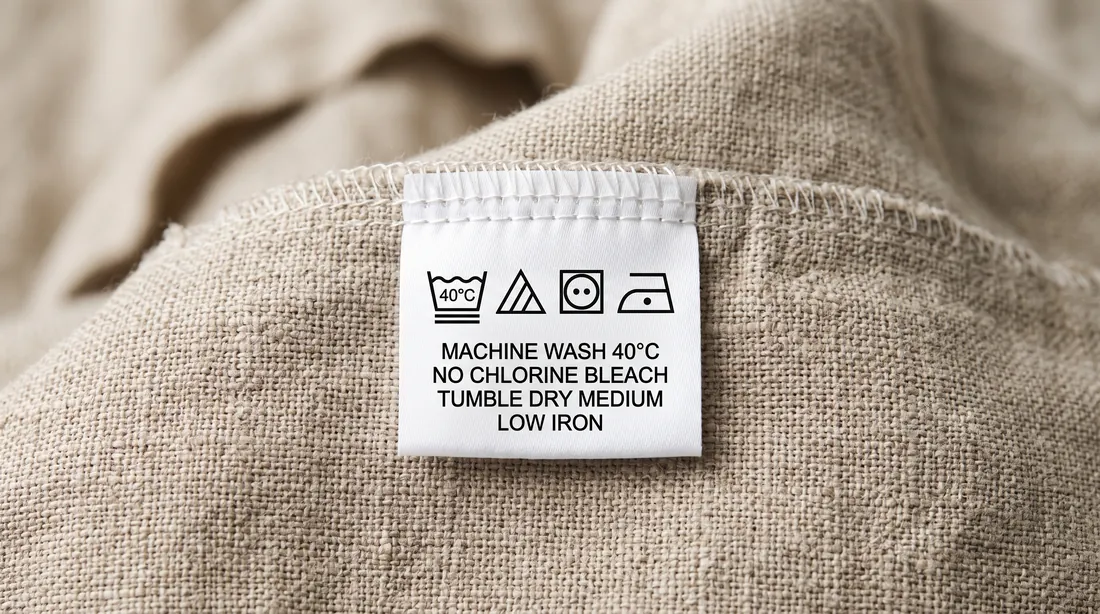
Since July 1997, symbols may replace words. The minimum laundering label is four symbols in a fixed order — washing, bleaching, drying, ironing — while dry-cleaning instructions are a single symbol. The symbols described below are North American; garments made elsewhere may use different systems. [1]
The symbols pictured below are redrawn as simplified line art from the chart in the University of Tennessee Extension publication cited on this page, which reproduces the FTC-accepted set (ASTM D5489-96c, Fig. 1). The chart also defines added dry-cleaning marks for short cycle, reduced moisture, low heat and no steam finishing; see the source PDF for those exact shapes.
The washtub: washing
A plain washtub means machine wash on a normal cycle. One bar under the tub means permanent press; two bars mean a delicate or gentle cycle. A hand in the tub means hand wash. A crossed-out tub means do not wash, and a crossed-out twisted symbol means do not wring. [1]
Dots inside the tub set the maximum water temperature: one dot is 30°C (65–85°F), two dots 40°C (105°F), three dots 50°C (120°F), four dots 60°C (140°F), five dots 70°C (160°F), and six dots 95°C (200°F). [1]
- Machine wash, normal
- Machine wash, permanent press
- Machine wash, delicate / gentle
- Hand wash
- Max 30°C / 65–85°F (one dot)
- Max 40°C / 105°F (two dots)
- Max 50°C / 120°F (three dots)
- Max 60°C / 140°F (four dots)
- Max 70°C / 160°F (five dots)
- Max 95°C / 200°F (six dots)
- Do not wash
- Do not wring
Symbol meanings from the cited chart. [1]
The triangle: bleach
An open, empty triangle means any bleach may be used when needed. A triangle with diagonal lines means only non-chlorine bleach when needed. A filled-in triangle with an X over it means do not bleach. [1]
- Any bleach when needed
- Only non-chlorine bleach when needed
- Do not bleach
Symbol meanings from the cited chart. [1]
The square: drying
A circle inside a square means tumble dry — plain for normal, one bar for permanent press, two bars for delicate/gentle. Dots inside the drum circle set the heat: no dot means any heat, three dots high, two dots medium, one dot low, and a filled circle means no heat (air only). [1]
Squares without the drum circle give non-tumble instructions: an envelope-fold line means line dry or hang to dry, vertical lines mean drip dry, a horizontal line means dry flat, and diagonal lines in the corner mean dry in the shade. A crossed-out symbol means do not tumble dry or do not dry that way. [1]
- Tumble dry, normal
- Tumble dry, permanent press
- Tumble dry, delicate / gentle
- High heat (three dots)
- Medium heat (two dots)
- Low heat (one dot)
- No heat / air only (filled circle)
- Line dry / hang to dry
- Drip dry
- Dry flat
- In the shade (added to line dry, drip dry or dry flat)
- Do not dry
- Do not tumble dry
Symbol meanings from the cited chart. [1]
The iron
Dots on the iron symbol set the maximum sole-plate temperature: one dot is 110°C (230°F, low), two dots 150°C (300°F, medium), three dots 200°C (390°F, high). A crossed-out iron means do not iron; crossed-out steam lines mean no steam. [1]
- Iron, low — 110°C / 230°F (one dot)
- Iron, medium — 150°C / 300°F (two dots)
- Iron, high — 200°C / 390°F (three dots)
- Do not iron
- No steam (added to iron)
Symbol meanings from the cited chart. [1]
The circle: dry cleaning
A plain circle means dry clean, normal cycle. A letter inside narrows the solvent: A means any solvent, P means any solvent except trichloroethylene, F means petroleum solvent only. Additional marks can call for a short cycle, reduced moisture, low heat, or no steam finishing. A crossed-out circle means do not dry clean. [1]
- Dry clean, normal cycle
- A — any solvent
- P — any solvent except trichloroethylene
- F — petroleum solvent only
- Do not dry clean
Symbol meanings from the cited chart. [1]
Beyond the symbols
The label also tells you the fiber content, which drives how a stain should be treated — see the materials pages for fiber-by-fiber constraints. Example labels on real garments read like "machine wash warm, non-chlorine bleach, tumble dry low, do not iron" for cotton, or carry "do not bleach" for silk and acrylic. [2]
Upholstered furniture uses a different system: letter cleanability codes (W for water-based cleaners, S for solvent only, W/S for either, X for vacuum only) on a tag rather than apparel care symbols. Our only fetched source for these codes is a furniture retailer's explainer, so treat that page as weakly sourced. [3]
Related
Sources
- Institutional University of Tennessee Agricultural Extension Service — Care Label Symbols (SP519) (accessed 2026-08-18)
- Institutional University of Tennessee Extension — Clothing and Textiles Intermediate Project Guide, Unit IV: Caring for My Clothes (W 1061-D) (accessed 2026-08-18)
- Community Keck Furniture (furniture retailer blog) — Upholstery Cleaning Codes Explained: W, S, W/S, X (accessed 2026-08-18)
Updated 2026-08-19. Compiled from the cited sources; not independently verified by this site. Spotted an error? See the corrections policy.