When to call a professional
The situations where our sources stop giving instructions and say to hand the item to a specialist cleaner or conservator.
Leather, suede, and fur
Washington State University's leather-care bulletin draws the home-care line clearly: dye-type stains such as ink and lipstick on leather are best removed by a professional cleaner, heavily soiled suede should go to a professional, and real cleaning of leather and suede garments requires a professional cleaner equipped for that work. [1]
The general stain guides agree: Kentucky Extension says not to treat suede, leather, or fur at home — take them to a specialist cleaner — and Michigan State's bulletin says not to attempt major stain removal on suede or leather at home. Georgia Extension routes rust stains on upholstery and leather to a professional cleaner as well. [2][3][4]
Wool carpet
WoolSafe's wool-carpet manual names three stains that may require treatment by a professional cleaner: bleach spots, rust, and old urine stains. [5]
Georgia Extension's per-stain pages send other carpet situations to professionals too: oil and grease stains that survive home treatment (the alternative it offers is patching the carpet), persistent felt-tip ink, and any ink on fur carpet. [6][7]
Old, fragile, or valuable textiles
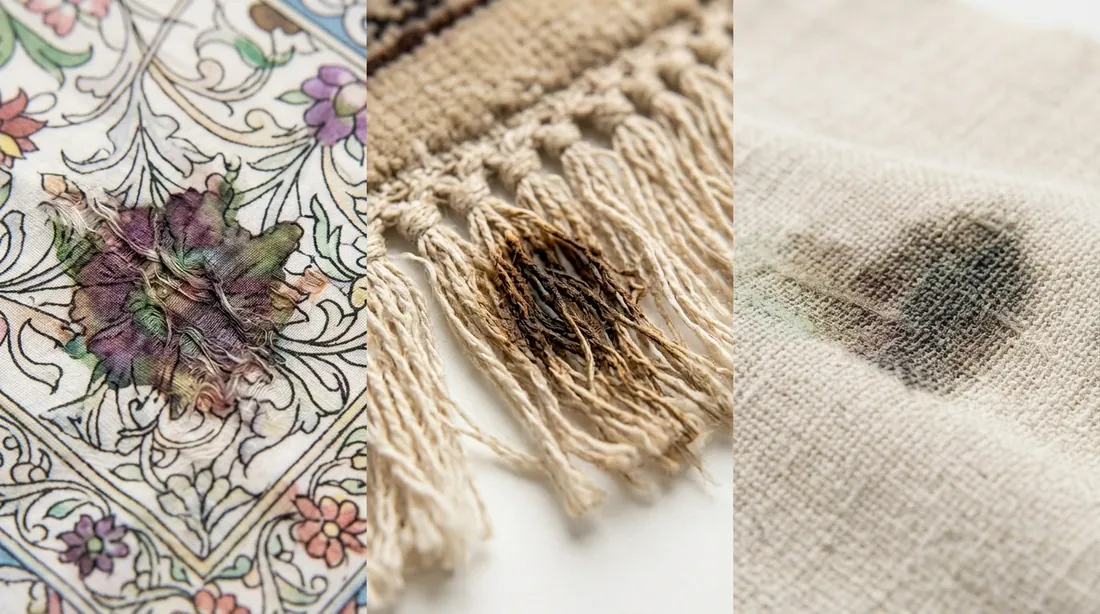
Museum sources are unanimous that antique and heirloom textiles are not a home stain-removal project. The Heinz History Center says not to try your own stain-removal experiments on antique textiles — over-the-counter products may harm delicate fabrics — and to consult a textile conservator. The Smithsonian's Museum Conservation Institute recommends professionals for old textiles where stain removal risks damaging the fabric through stress, and for complex multi-solvent jobs like ink and paint. [8][9]
Nebraska Extension says very old, fragile, or valuable quilts should be cleaned only by a professional textile conservator — contact a museum, a university, or the American Institute for Conservation for referrals. The Museum of the Albemarle lists the situations that call for a conservator: mold (an emergency), fragile textiles, beadwork and delicate seams, and fire or water damage. [10][11]
Dry-clean-only garments
Texas A&M's rule: when in doubt, take the garment to a professional dry cleaner, and take dry-clean-only fabrics to the cleaner promptly, identifying the stain. Woolmark adds that if a treated wool item goes to the dry cleaner, you should tell them what the stain was and what you already applied to it. [12][13]
What this list is
This page only collects the referrals our fetched sources make explicitly. A professional is also a reasonable choice any time an item matters more to you than the cost of the cleaning — but that judgment call is yours, not a sourced instruction.
Related
Sources
- Institutional Washington State University Cooperative Extension Service — Care of Leather & Suede Garments (EM 4335, May 1978) (accessed 2026-08-18)
- Institutional University of Kentucky Cooperative Extension Service — Stain Removal for Washable Fabrics (FCS2-840 / H.E. 2-840) (accessed 2026-08-18)
- Institutional Michigan State University Cooperative Extension Service — Stain Out — A General Guide to Stain Removal (Extension Bulletin E-1453) (accessed 2026-08-18)
- Institutional University of Georgia Extension — Remove Stains from Iron, Rust (accessed 2026-08-18)
- Industry body The WoolSafe Organisation — The Cleaning & Maintenance of Wool Carpets (2020) (accessed 2026-08-18)
- Institutional University of Georgia Extension — Remove Stains from Oil (accessed 2026-08-18)
- Institutional University of Georgia Extension — Remove Stains from Ink (Ballpoint, Felt Tip, India, Mimeo, Stamp Pad) (accessed 2026-08-18)
- Institutional Heinz History Center (Smithsonian-affiliated museum) — Conservation and Care: How to Care for Textiles (accessed 2026-08-18)
- Institutional Smithsonian Museum Conservation Institute — Stain Removal (accessed 2026-08-18)
- Institutional University of Nebraska-Lincoln Extension — Care of Quilts: Cleaning (NebGuide G1821) (accessed 2026-08-18)
- Institutional Museum of the Albemarle (North Carolina Division of State History Museums) — How to Care for Your Textiles (accessed 2026-08-18)
- Institutional Texas A&M AgriLife Extension — Removing Stains from Washable Fabrics (accessed 2026-08-18)
- Industry body The Woolmark Company — Removing Stains from Wool (accessed 2026-08-18)
Updated 2026-08-18. Compiled from the cited sources; not independently verified by this site. Spotted an error? See the corrections policy.