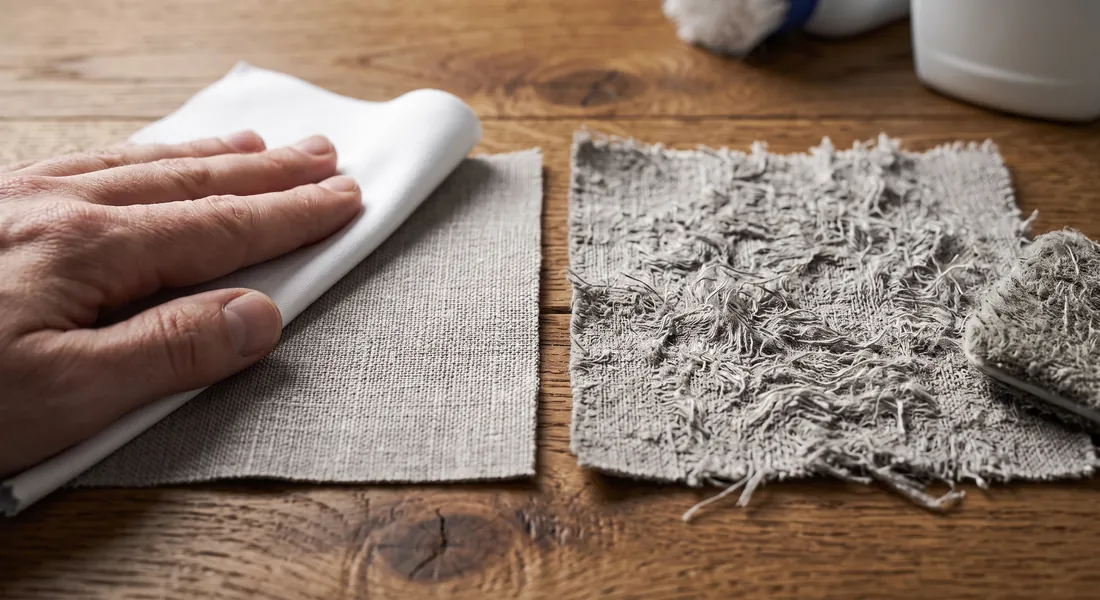
Blotting vs. rubbing
Why every carpet, stone, wool, and leather source says to blot a spill — and what rubbing or wiping does instead.
Blot — don't scrub
The Carpet and Rug Institute's cleaning guidance is blunt: blot liquids with a dry white absorbent cloth or plain white paper towels, and do not scrub or use a brush — bristles and scrubbing can damage carpet. University stain guides give the same instruction for fabric: blot, don't rub. [1][2][3]
Wool sources are equally strict. Woolmark's stain guidance for wool garments says to blot with a lint-free cloth and never rub, and WoolSafe's wool-carpet manual says to scoop solids and blot liquids first while avoiding rubbing the carpet surface — damage in wet cleaning usually comes from over-wetting, too much mechanical action, and unsuitable chemicals. [4][5]
Wiping spreads the spill
On natural stone, the Natural Stone Institute says to blot a spill with a paper towel immediately and not to wipe the area, because wiping spreads the spill. Georgia Extension's oil instructions carry the same warning for greasy spills: blot with paper towels, don't rub. [6][7]
Ink illustrates the worst case: Georgia Extension's ink page says never to rub ink stains on carpet. [8]
Work from the edge inward
Carpet and wool sources agree on direction: work gently from the edges of the stain toward the center so you don't spread it. CRI says to work from the edges to the center, WoolSafe says to always work from the edge of the stain inwards, and Woolmark says to work from the edge to the centre. [1][5][4]
One older source describes the opposite motion: Michigan State's 1980s general stain bulletin teaches sponging from the center out toward the edge. We record that as a disagreement rather than resolving it; the current carpet and wool industry sources above all say edge inwards. [9][1][5][4]
Both CRI and WoolSafe also say to apply the cleaning agent to a white cloth or towel, not directly onto the carpet, and to use white materials only — printed or colored cloths can transfer dye into the spot you're cleaning. [1][5]
Delicate surfaces
On leather, Washington State University's leather-care bulletin says to blot water-soluble stains with a soft damp cloth before the stain dries, using a patting or blotting motion only. On heirloom textiles, Georgia Extension says never rub or scrub at all. [10][11]
Related
Sources
- Industry body Carpet and Rug Institute — Cleaning and Maintenance (accessed 2026-08-18)
- Institutional University of Kentucky Cooperative Extension Service — Stain Removal for Washable Fabrics (FCS2-840 / H.E. 2-840) (accessed 2026-08-18)
- Institutional Iowa State University Extension and Outreach — Common Holiday Stain Removal Guide (AnswerLine) (accessed 2026-08-18)
- Industry body The Woolmark Company — Removing Stains from Wool (accessed 2026-08-18)
- Industry body The WoolSafe Organisation — The Cleaning & Maintenance of Wool Carpets (2020) (accessed 2026-08-18)
- Industry body Natural Stone Institute — Stain Removal (Consumer Resources) (accessed 2026-08-18)
- Institutional University of Georgia Extension — Remove Stains from Oil (accessed 2026-08-18)
- Institutional University of Georgia Extension — Remove Stains from Ink (Ballpoint, Felt Tip, India, Mimeo, Stamp Pad) (accessed 2026-08-18)
- Institutional Michigan State University Cooperative Extension Service — Stain Out — A General Guide to Stain Removal (Extension Bulletin E-1453) (accessed 2026-08-18)
- Institutional Washington State University Cooperative Extension Service — Care of Leather & Suede Garments (EM 4335, May 1978) (accessed 2026-08-18)
- Institutional University of Georgia Extension (Textiles) — Care and Storage of Textile Heirlooms (accessed 2026-08-18)
Updated 2026-08-18. Compiled from the cited sources; not independently verified by this site. Spotted an error? See the corrections policy.