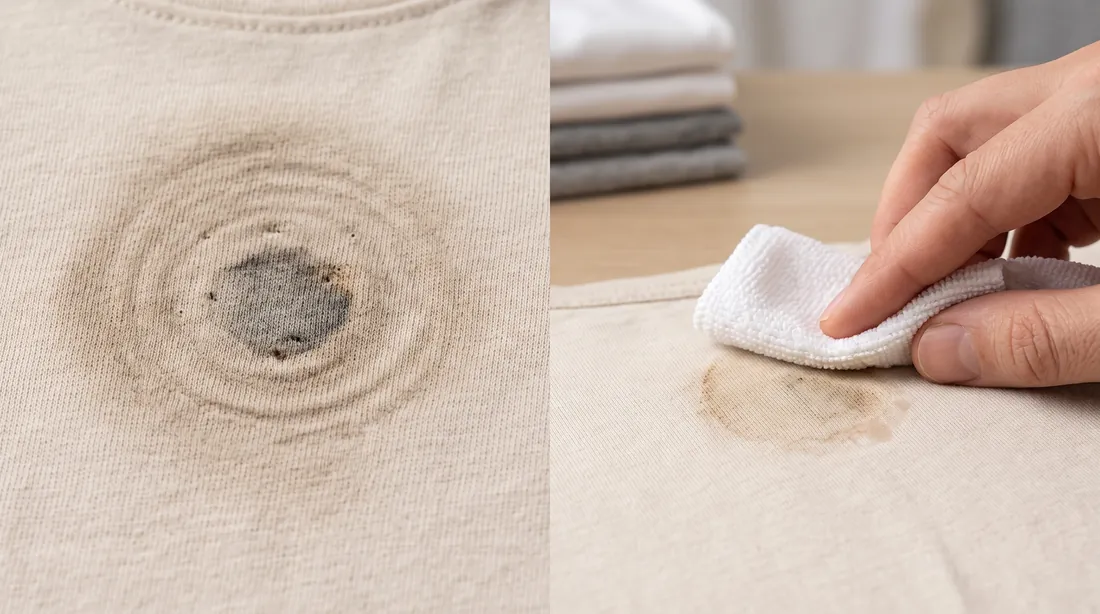
Heat sets stains
Hot water, the dryer, the iron, and steam can all make a removable stain permanent. What the sources actually say, stain by stain.
The rule
Texas A&M's washable-fabrics guide states it as a general law: heat sets stains — do not machine-dry or press a garment until the stain is fully removed. Kentucky Extension's stain publication says never to iron stained fabrics for the same reason, and Iowa State's guidance says to inspect wet clothing before machine drying because heat permanently sets whatever stain remains. [1][2][3]
Hot water and protein stains
For protein stains — a group that includes blood, milk, baby formula, vomit, feces, and urine — Kentucky Extension explains that if hot water is used first, it cooks the protein and causes coagulation between the fibers, making the stain harder to remove. The instruction is to soak in cold water first and launder in warm, not hot, water. [2]
Blood is the clearest example. Tide's instructions say to rinse, soak, and wash blood in cold water only, because hot water will set the stain; Georgia Extension's blood page uses cool water in every step, on every surface. [4][5]
The dryer is the point of no return
Manufacturer instructions repeat the same checkpoint across stain types: if the stain is still visible after washing, repeat the treatment before machine drying, because drying will set the stain. Tide says this for blood, deodorant, sunscreen, and coffee. [4][6][7][8]
Illinois Extension's stain pages describe what happens if you miss the checkpoint: a stain that has been laundered and then dried is nearly impossible to remove. [9][10]
Steam and irons
The Carpet and Rug Institute warns never to steam clean urine spots on carpet — heat sets both the stain and the odor; extract with a wet vacuum and rinse with cool water instead. Georgia Extension warns never to iron or apply heat to a deodorant stain, because the combination damages most fabrics. [11][12]
Fresh vs. set: why speed matters
The Smithsonian's Museum Conservation Institute says the older the stain, the harder it is to remove — stains under about two months old generally remain treatable, but fresher is always better. Its example is sugar: syrup residue caramelizes with time or heat, turns brown, and becomes permanent if untreated. Oily stains that have oxidized and yellowed no longer respond to the methods that work on fresh oil. [13]
The extension sources agree at shorter time scales: fresh stains are much easier to remove than stains over 24 hours old, dried stains oxidize and become much harder to remove, and old stains may be impossible. [14][15][1]
Some stains have their own point of no return even without heat: Georgia Extension says latex paint may become permanent if allowed to dry, and dried India ink may be impossible to remove. [16][17]
Related
Sources
- Institutional Texas A&M AgriLife Extension — Removing Stains from Washable Fabrics (accessed 2026-08-18)
- Institutional University of Kentucky Cooperative Extension Service — Stain Removal for Washable Fabrics (FCS2-840 / H.E. 2-840) (accessed 2026-08-18)
- Institutional Iowa State University Extension and Outreach — Holiday Stains (AnswerLine) (accessed 2026-08-18)
- Manufacturer Tide (Procter & Gamble) — How to Remove Blood Stains (accessed 2026-08-18)
- Institutional University of Georgia Extension — Remove Stains From Blood (accessed 2026-08-18)
- Manufacturer Tide (Procter & Gamble) — How to Remove Deodorant Stains (accessed 2026-08-18)
- Manufacturer Tide (Procter & Gamble) — How to Remove Sunscreen Stains (accessed 2026-08-18)
- Manufacturer Tide (Procter & Gamble) — How to Remove Coffee Stains Fast and Effectively (accessed 2026-08-18)
- Institutional University of Illinois Extension — Grease — Stain Solutions (accessed 2026-08-18)
- Institutional University of Illinois Extension — Chocolate, cocoa — Stain Solutions (accessed 2026-08-18)
- Industry body Carpet and Rug Institute — Cleaning and Maintenance (accessed 2026-08-18)
- Institutional University of Georgia Extension — Remove Stains From Antiperspirant, Deodorant (accessed 2026-08-18)
- Institutional Smithsonian Museum Conservation Institute — Stain Removal (accessed 2026-08-18)
- Institutional Iowa State University Extension and Outreach — Common Holiday Stain Removal Guide (AnswerLine) (accessed 2026-08-18)
- Institutional Iowa State University Extension and Outreach — Summer Food Stain Removal (AnswerLine) (accessed 2026-08-18)
- Institutional University of Georgia Extension — Remove Stains from Paint (accessed 2026-08-18)
- Institutional University of Georgia Extension — Remove Stains from Ink (Ballpoint, Felt Tip, India, Mimeo, Stamp Pad) (accessed 2026-08-18)
Updated 2026-08-18. Compiled from the cited sources; not independently verified by this site. Spotted an error? See the corrections policy.